


By Ethan Royer
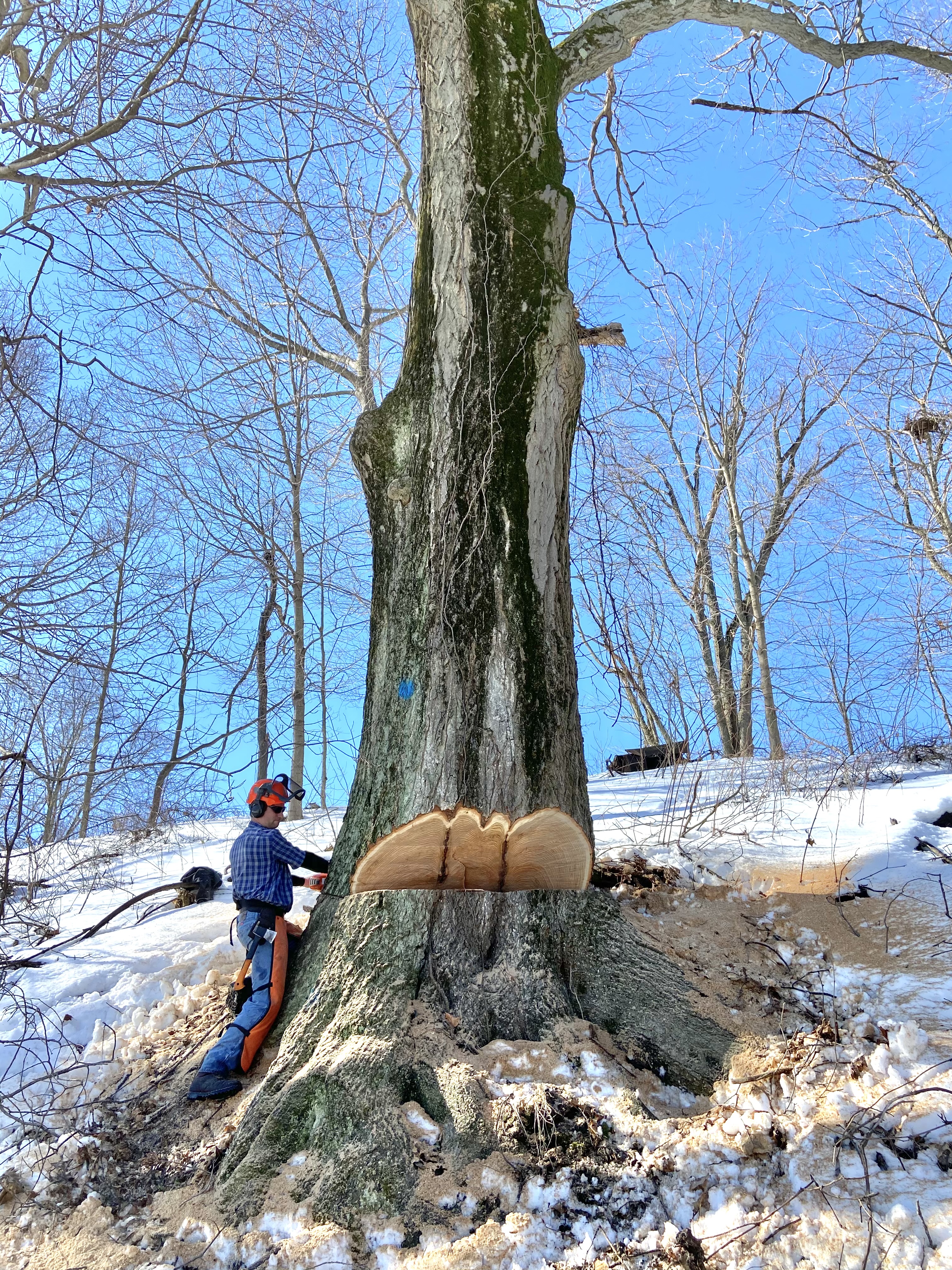
People, regardless of whether they are loggers or normal people, enjoy talking about big trees. Big, of course, is a relative term. Landowners often call their trees huge when describing them to a prospective timber buyer. True giants are rare in northern Indiana, but we do encounter them occasionally. While it is always fun and literally earth-shaking to fell gigantic trees, part of the fun is in photographing, measuring, and telling about it.
Certain species come to mind when thinking of giant trees: cottonwood, tulip poplar, sycamore, and various types of oak are most likely to achieve mammoth size. Others, black cherry, locust, elm, and aspen, usually blow over, rot, or die before they can. Even among the potential giants, few survive to gianthood. The secret sauce of tree longevity is hard to know, but the recipe includes fertile soil, adequate water, and a good root system. Add to that sufficient sunlight, evading lightning, escaping hungry deer, and avoiding loggers with chainsaws and boys with hatchets, and a tree may live long enough to grow huge.
The species most associated with exceptionally big trees may be the oak, particularly the burr oak. Burr oak is in the white oak family and can get huge while remaining sound. It is rot-resistant and does well at compartmentalizing injuries.
The Bible has many references to oak trees, such as when Absalom got hung in the tree by his hair in a "thick oak". Oaks are historically significant; many Bible references to oaks describe burials, memorials, or other important events as happening "under an oak." The Indians had Council Oaks where important meetings took place. One of these historic Council Oak trees was in nearby South Bend until struck by lightning in 1992. It is said that French explorer La Salle held a council with Indian leaders here in 1681 that led to the Miami treaties.
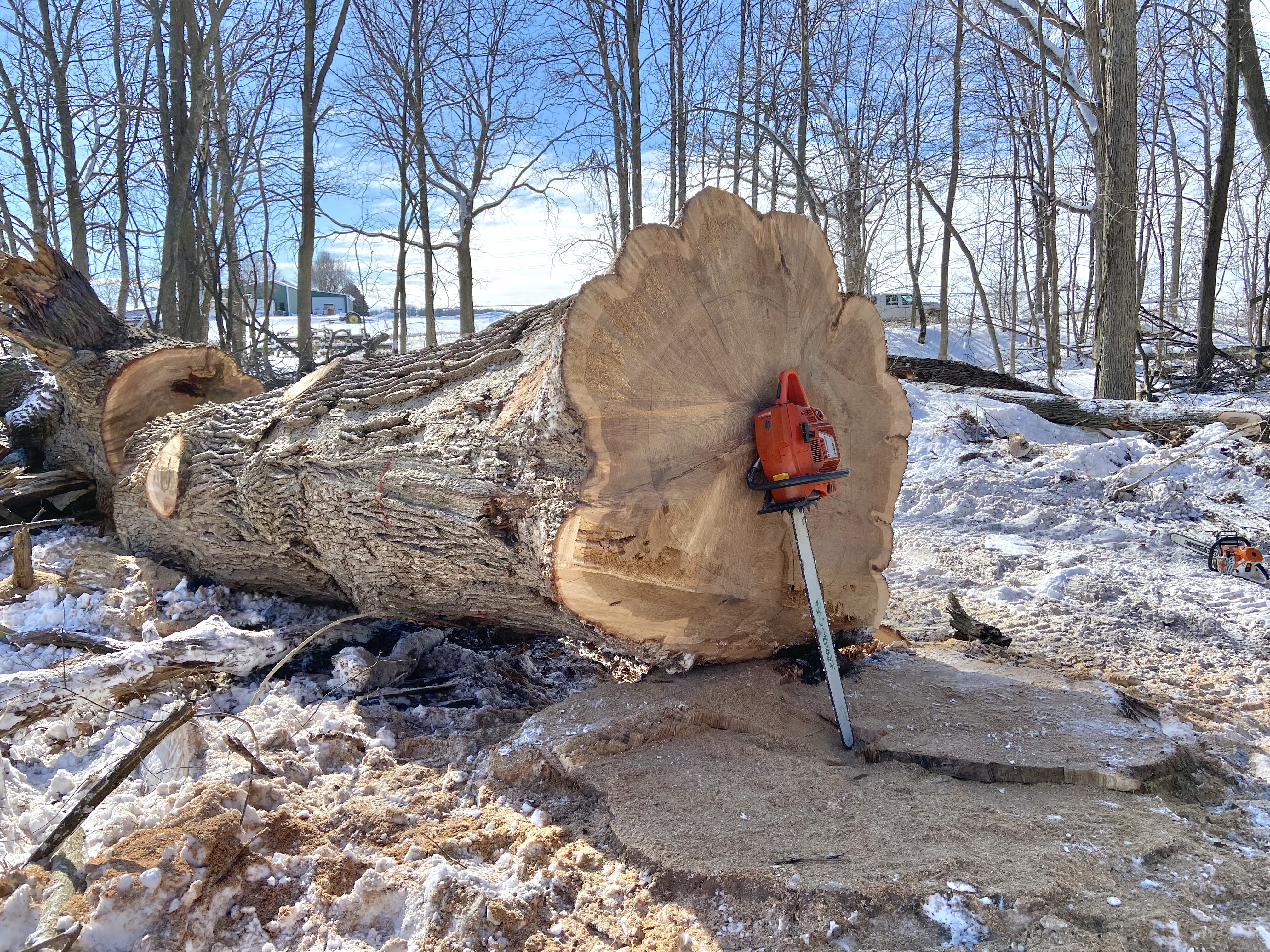
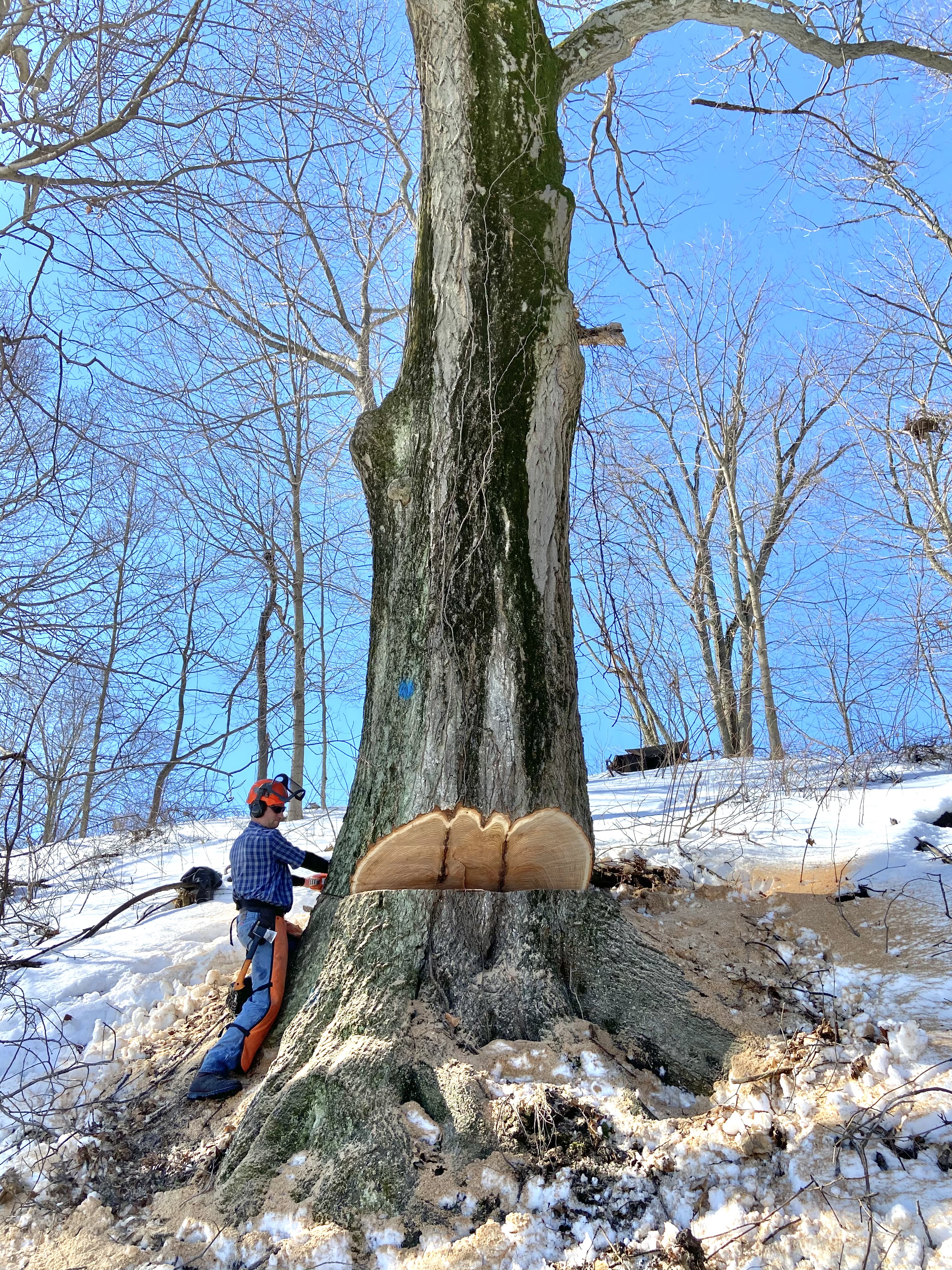
We'd logged for my neighbor several times, and he had a giant burr oak in his woods that he would not let us cut; he said it was a landmark. But a few years ago, we logged his woods again and he said, "Let's cut that tree, I don't know why we didn't cut it before." It was starting to have some rot issues in the top, and some of the spreading limbs were breaking off. It turned out to be 100% solid at the butt and measured about 72” in diameter. It was still 54" at 18'. I wish we would've scaled it, but the Doyle scale stick stops at 48", and I didn't know of charts available that go beyond that. I seldom count growth rings on the trees we cut, but I did count them on this one. Some of the rings were so close together that it was hard to count accurately, but it came to around 245 years old.
It is intriguing to think that it would've been a seedling in 1776 when the Declaration of Independence was signed. I would assume there were still Native Americans roaming these parts back in 1776. Was it one of the storied Council Oaks? Probably not because it would not have been big enough back then, but it is interesting to imagine that this tree could've been wiped out by a warrior with a tomahawk! We cut this tree with a 36" bar but later borrowed a saw with a 48" bar to cut a souvenir slab off the stump. The slab is drying now, but maybe someday I'll make a timeline out of it, perhaps marking the dates of ancestors or important dates in American history.
A farmer once hired me to cut a hollow sycamore tree with an over 4' diameter to make way for an irrigation pivot. Having only a 4" rind of solid wood around the edge, it had no log value, so he laid it aside, hoping to find some use for it. A while later, I saw a wanted ad for a large hollow log to use as a smokehouse for a Native American reenactment event. Although it was punky by this time, they did come get a section of it; apparently huge hollow logs are hard to source.
I know of a large (5'+) white oak that will probably not be harvested until it rots or falls over. The landowner and his family have even given it a name—Papa Bear. Two other big trees close to it are named Momma Bear and Baby Bear. Sometimes, sentimental value trumps cash value.
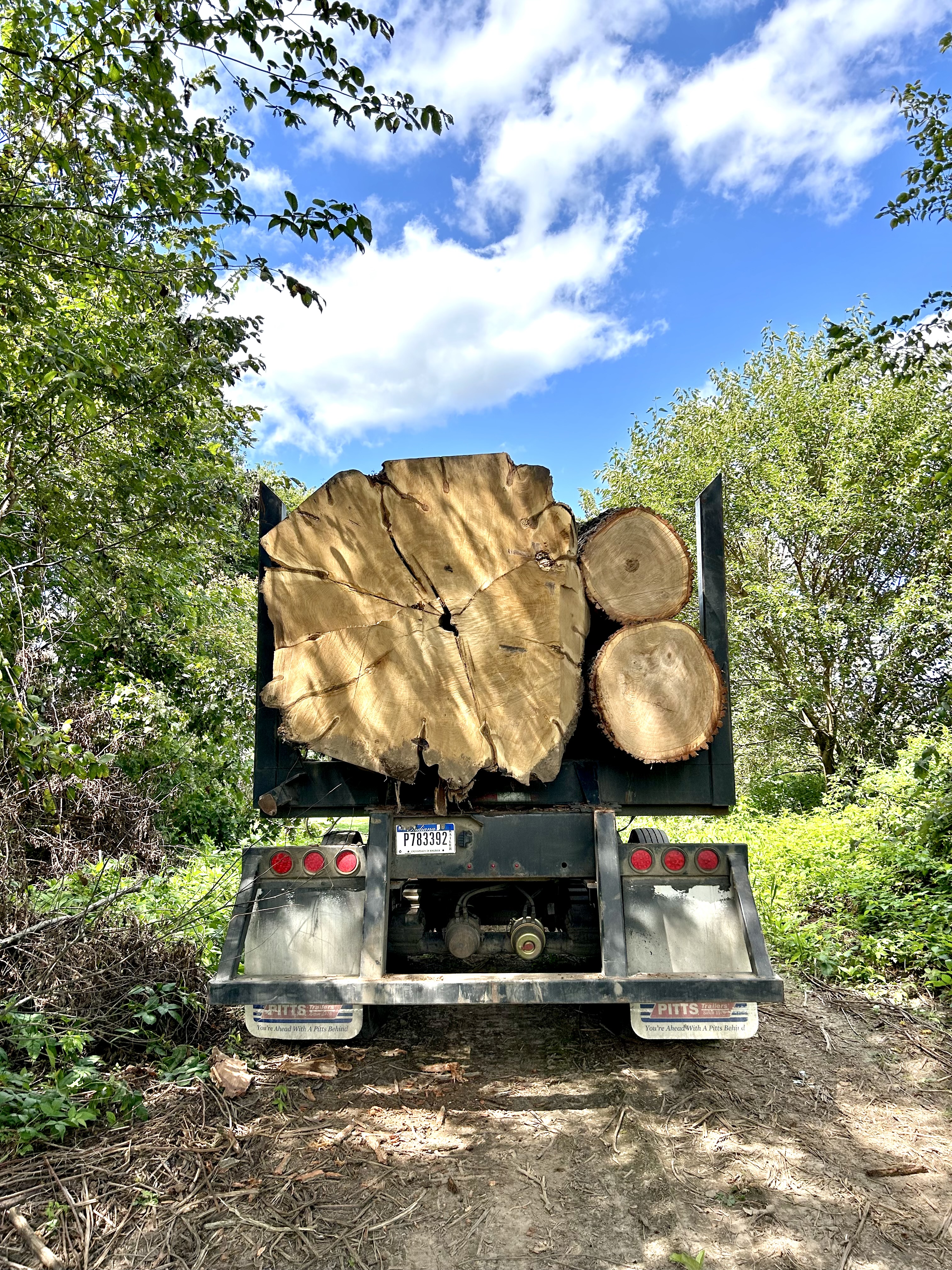
While fun to cut and talk about, oversized trees are a nuisance in most other ways. Logging equipment is designed for normal sized timber, and it can be difficult to skid and load monster trees. Most mills in this area do not accept logs greater than 48" in diameter. There are some niche options like the tabletop slab market, but they aren't interested in all species. It seems logical that rarity would create value, but limited outlets reduce competition. We've encountered a situation where only one person was interested in the log we had, allowing them to name their price.
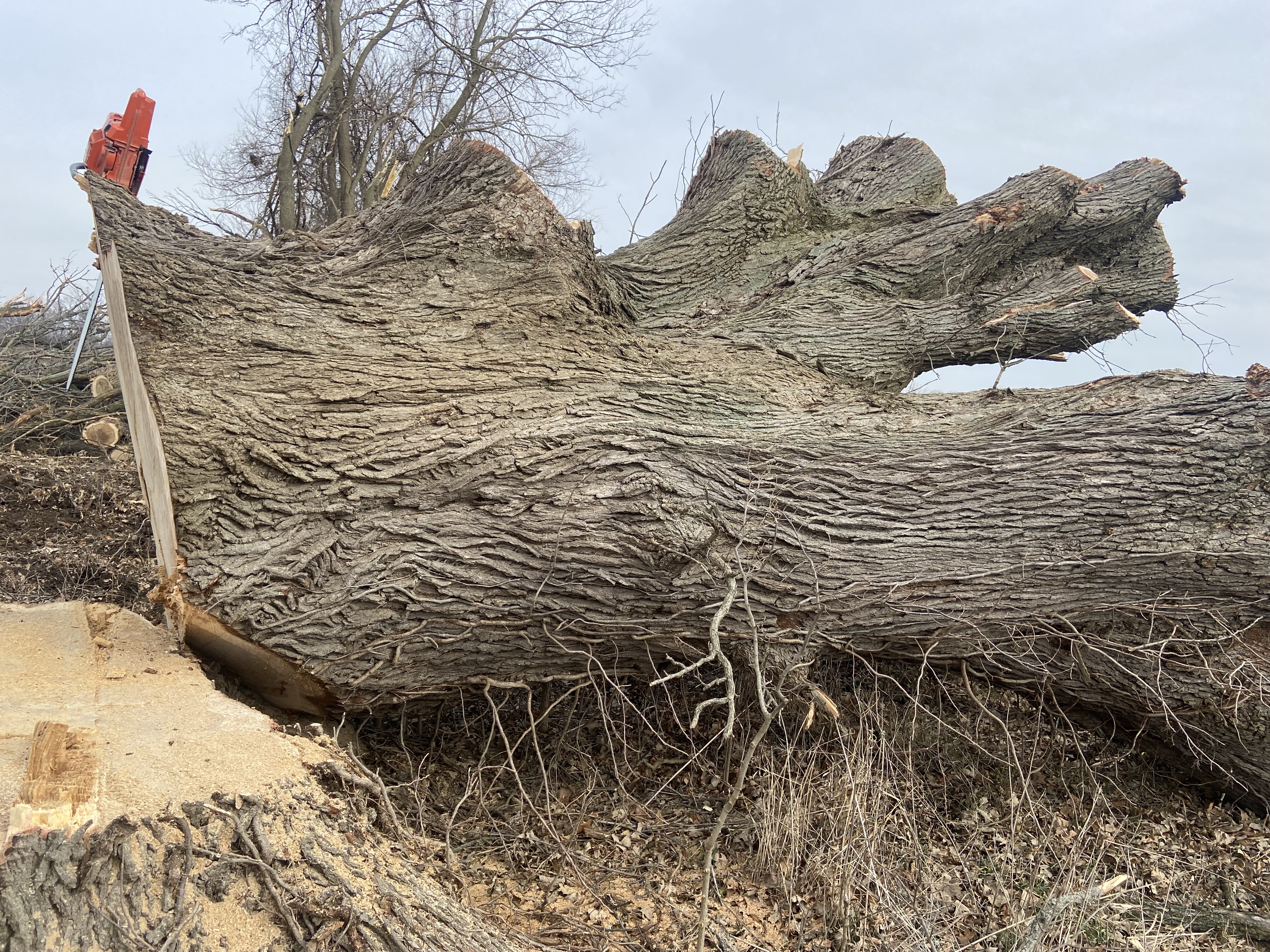
Sometimes trees that are very large in diameter are not very nice in other ways.. The most healthy and vigorous trees typically have access to plenty of light, have many limbs, and resemble a head of broccoli—about as wide as they are tall. In other words, a fencerow or yard tree. It takes much of the joy out of cutting a huge tree when it only falls to about a 45° angle and stops because of all the huge limbs holding it up. Big trees growing inside woods are usually much easier to fell and top; they generally have a large crown too, but it is not just 20-30' above ground.
Should a landowner let his trees go unharvested until they are huge? No. It is usually counterproductive to let one huge tree hog the sunlight that could be growing several smaller trees. Also, while trees that are very large and very tall are fun to cut, they are quite destructive to the surrounding trees when they fall. Sometimes, even the top logs are reduced to splinters from the force of the impact. On the plus side, due to their sheer weight, they never hang up in other trees.
The post-harvest appearance of a tract full of oversized timber is usually quite ugly for several reasons: (1) The trees are big and cause a lot of collateral damage. (2) Many trees need to be harvested to remove all the mature and overmature trees. (3) Woods dominated by very large trees typically have very little understory growth, so when the overstory is removed, not much is left of the woodlot.
It is difficult to mark timber in a stand that has gone unharvested for too long. If I mark everything that should be cut, the results are ugly, and I risk upsetting the landowner. But leaving some of the mature trees is not good either because they may not last until the next harvest. Even if they do last, they will be oversized, overripe, and may smash the new growth in the openings created by the initial harvest. As a consultant forester once said about an overdue harvest, "We need to take two harvest's worth of timber in a single harvest."
Another thing against oversized trees is that at some point, added volume no longer equals added value. On some trees, economic maturity and biological maturity are two different things. A good illustration is Sugar Maple trees. When they are small to medium, the wood tends to be white, but as they reach maturity or overmaturity, the ratio of brown heartwood to white sapwood increases, devaluing the log. Veneer mills may not accept a log if it is bigger than their lathe or slicer can handle. This degrades a would-be veneer log to a lumber log. One thing is certain, if you see racoons crawling out of holes in the tree, you have missed both economic and biological maturity.
What options do we have with a log that is too large for local mills and unwanted by tabletop slab producers? I think of three options: (1) Using a chainsaw to break it down to useable dimensions. (2) Discarding the log. (3) Last, but certainly not least, is blowing the log into several pieces. They each have their pros and cons. Breaking the log down with a chainsaw is the most controlled method, but it's time consuming and no fun. Discarding the log is easy but unprofitable. Blowing is a lot of fun and is a technique I'd be glad to demonstrate, but it only works on certain species. I won't go into detail on how it's done other than to say it involves copious quantities of gun powder, an impressive concussion, flying objects, questions from neighbors, and sometimes, success.
I visited Calaveras Big Trees State Park in California a few times in my younger years, and it is on my bucket list of places to visit again sometime. It is awe-inspiring for anyone but especially for those in the timber industry. Perhaps the logger blood runs too thick in my genes, but as I stood there admiring those huge trees, I almost drooled over the thought of cutting one down. On one hand, it is disgusting to know that the tremendous amount of wood from all those behemoths will go to waste, but on the other hand, I am glad that some were preserved for us to enjoy.
Someday, I'd like to visit Sequoia National Park and see the tree named General Sherman. It is purportedly the largest living tree on earth by footage: it is estimated to contain over 600,000 board feet! It takes me down a notch to realize that one tree contains more footage than the entirety of any single job we've ever done.
Good forestry is not a contest to see how large of trees can be grown, so harvest at the appropriate time. Determining when trees are mature is a bit like trying to tell if a watermelon is ripe. It is hard to pinpoint maturity, but there are visible clues to an experienced eye. For instance, the bark of a mature walnut usually looks different than an immature walnut. Seek the advice of someone you can trust.
If the opportunity comes along to harvest a giant tree, enjoy the challenge, remember Who created them, and share the stories without boasting. It is humbling to think that a giant tree lives far longer than we do.
Ethan Royer, of Royer Logging, lives with his family in northern Indiana and provides logging services in northern Indiana and southern Michigan. He can be reached at 574.849.0867.
This article was originally published in Plain Communities Business Exchange (PCBE). Reprinted with permission. To subscribe to PCBE, call (717) 362-1118 or visit https://pcbemagazine.com