


By Ethan Royer
Last month, I covered the positive aspects of harvesting timber mechanically. This month, I'll try to detail the other side of the story. As I've admitted before, I am biased toward mechanical cutting. In my experience, the positives outweigh the negatives, but it's not all fun and games. It will not work for all loggers in all situations. Some of these negatives are the very same things listed as positives last month—sometimes too much of a good thing becomes a bad thing. Other times, carelessness turns a good thing into a bad thing.
Cost
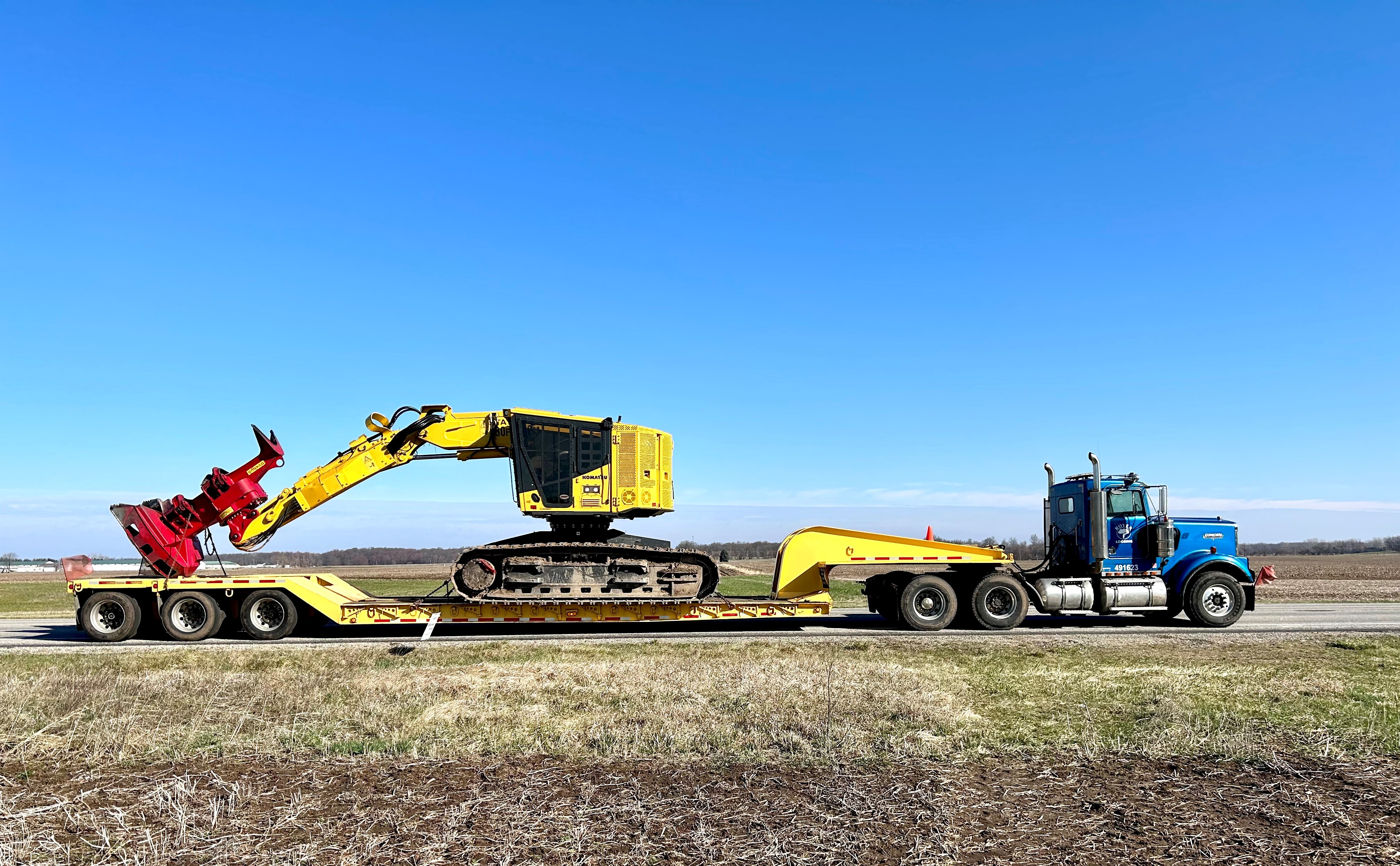
The major financial burden of mechanical cutting is a big drawback. Bunchers are expensive machines that depreciate relatively quickly. The used equipment market seems to be softening, but feller bunchers still can't be categorized as cheap. You could expect a new buncher to be $700 to $900K, depending on brand, model, options, and attachment. The days of 0%-interest loans appear to be history, so borrowing costs add significant expense. As we discovered, switching to mechanical cutting involves more than just buying a feller buncher. We bought a semi and lowboy to transport it and later acquired a bigger skidder to keep up with pulling wood away from the feller buncher. While not everything has to be purchased in one fell swoop, there is significant upfront cost however you do it.
It was definitely a leap of faith for us to invest so much into a method that was unproven in our area at that time. Perhaps the difference between a leap of faith and a leap of folly depends on whether those you are accountable to approve of the leap. Of course, we had tried to run the numbers before we pulled the trigger, but a lot of our figures were pure speculation: we didn't really know what kind of production to count on or what the operational costs would be. Fear of failure can be paralyzing, but it can also motivate you to figure out ways to make things work. Sometimes desperation drives innovation.
Our first buncher was bought used and served us well, but when we were ready to update in 2021, used equipment prices were soaring while new equipment had not yet spiked. With 0%-interest loans available, and my lack of mechanical aptitude, buying new seemed like the logical choice. For anyone getting into mechanical cutting, I would strongly caution against maxed-out borrowing. It is difficult to make good operating decisions when you are heavily leveraged and are struggling to make payments. Monthly payments are due, rain or shine. You don't want to feel forced to work when the ground is too soft. Debt can be a good servant, but it's a terrible master.
A chainsaw can cut all day on a couple gallons of gas; a buncher cannot. Fuel is a major expense that is difficult to accurately project since the price fluctuates so much. In 2023, I paid as much as $4.10 a gallon; at the time of this writing, fuel is down to $2.15. I do not carefully track fuel consumption, and I know it varies some, but it is somewhere in the ballpark of 10 gallons per hour for the buncher and 4 gallons per hour for the skidder. Doing the math reveals a $218.40 difference per day at 8 hours of run time (112 gal. x $4.10 = $459.20; 112 gal. x $2.15 = $240.80).
I transport fuel to the job via a 100-gal. tank in my pickup, but I cannot keep up with the buncher and skidder on longer days, especially when the skids are long. (We don't usually run for 8 hours since we still buck by hand most days.) Going through this amount of fuel prompted the purchase of a large fuel tank so we can buy by the semi load.
The cost of maintenance and repairs is a known unknown. While maintenance is fairly predictable, repairs are a different story. We know there will be repairs, just not how many or when they will be needed. The price tag on heavy equipment repairs makes chainsaws look downright cheap. A simple and inevitable thing like blowing a 1" hydraulic hose can easily cost over $500, not figuring labor or downtime. The cost of a service call from an OEM dealer is out of line with logger's wages. Our new machine purchase came with the Komatsu Care complimentary service program, but after that expired, I began servicing the machine myself. I was a bit startled at the cost of some filters. A routine 1,000-hour service cost over $1,000 for just the oil and filters. It requires four different types of oil, some are inexpensive and some are not.
Saw teeth run around $150 per set of twelve. In ideal conditions, we can cut about 200,000 board feet per set, but that is rare. Most often, they dull prematurely by hitting a rock, barbed wire, tree step, or T-post. If the teeth are not damaged, I will resharpen them once.
Downtime for repairs must be accounted for as well. When we switched from hand cutting, we told ourselves that if the buncher were to break down, we could always hand cut for the rest of the day—but that is not how it works. If the buncher goes down, we do everything we can to get it back up and going. Our buncher is under warranty, so repairs are covered, but it was recently at the dealer for three weeks for warranty work. We filled in with some hand jobs, but I struggled to stay charitable. Downtime is all the more costly when we are so limited on working days due to wet weather.
We had no experience with undercarriages before buying a buncher, but we soon discovered that undercarriages alone are a major expense. When the Komatsu -5 series debuted, I remember a company rep telling me that they redesigned the undercarriage to last 8,000 hours. I thought he was trying to be funny, so I laughed, but he was serious. I put 2,000 hours on mine before Komatsu themselves declared it worn out.
There is no warranty on the undercarriage since it's considered a wear item, but they did pay for a portion of the replacement since they said it was premature wear. We sometimes work in sand, and I do track and turn a lot more than a processor would, but I don't understand why the undercarriage didn't last longer. Even if we use aftermarket components, I calculate that the undercarriage alone is costing at least $15 an hour.
Liability is a real consideration of owning a machine that could be burnt, stolen, or vandalized. We don't have many pine needles (notorious for getting inside guarded machines), but my first buncher nearly caught fire one summer day. It had not rained for some time, and the sawdust inside the engine compartment was tinder dry. As I was tracking out of the woods, I started smelling smoke. I shut down and climbed out to investigate but couldn't find anything. I climbed back in and headed for the landing but began smelling smoke again.
Arriving at the landing, we discovered live coals on the backside of the engine. They had not yet ignited, but the engine fan was blowing on them and I'm confident there soon would've been flames. It appeared the culprit was a nut that fell off an exhaust clamp near the turbo and dropped into the sawdust under the engine. This was one of the only times that I've been thankful for a swamp; we dipped water out of a nearby swamp and doused the coals. I like to pressure wash the engine compartment periodically but don't do it as often as I'd like; few jobs have hydrants handy.
Finding Qualified Operators
As a buncher owner-operator, I cannot identify with the issue of finding a qualified operator, but I know that is a real dilemma for some companies. The learning curve is not short. A forestry equipment salesman once told me that it takes 1,500 to 2,000 hours before an operator's skill and production plateaus. Based on my experience, I would say this is accurate, but it's also possible that I'm a slow learner. Since mechanical cutting is new to this area, it isn’t possible to find a skilled operator for hire. The most important criteria for a good operator are conscientiousness and a working knowledge of forestry (that is, knowing tree species, wood fiber characteristics, and the importance of directional felling).
In other words, a good hand cutter could likely become a good buncher operator. Anyone can learn to run joysticks, but discipline and quality workmanship are more important and more difficult to teach. I recommend starting out a new operator in low-grade timber, clearcuts, or blowdowns to get a handle on machine control. Even the most careful operator can't do a good job until he can make the machine behave.
It is said that "Power corrupts and absolute power corrupts absolutely." Bunchers are powerful tools, and it is easy to be corrupted into laziness. My thoughts might go like this: "Who wants to climb out and hand cut that big Walnut when it's 90° outside?" Or, "If I just leave a high stump, I can do it from the air-conditioned cab." It takes discipline to do a good job regardless of the method, but I think the feller-buncher method requires even more discipline. Little things add up more when you're cutting twice as many trees per day.
Soil Disturbance
This was listed as a positive thing last month, and it is positive in the right circumstances. But it can also be a bad thing. Bare soil enables seed-to-soil contact, promoting regeneration, but this can be good or bad. It might depend on whether the Oaks are dropping acorns or cotton is floating off the Cottonwood trees.
Too much soil disturbance can trigger erosion on steeper sites, and no one appreciates a new gully in their woods.
Log Quality
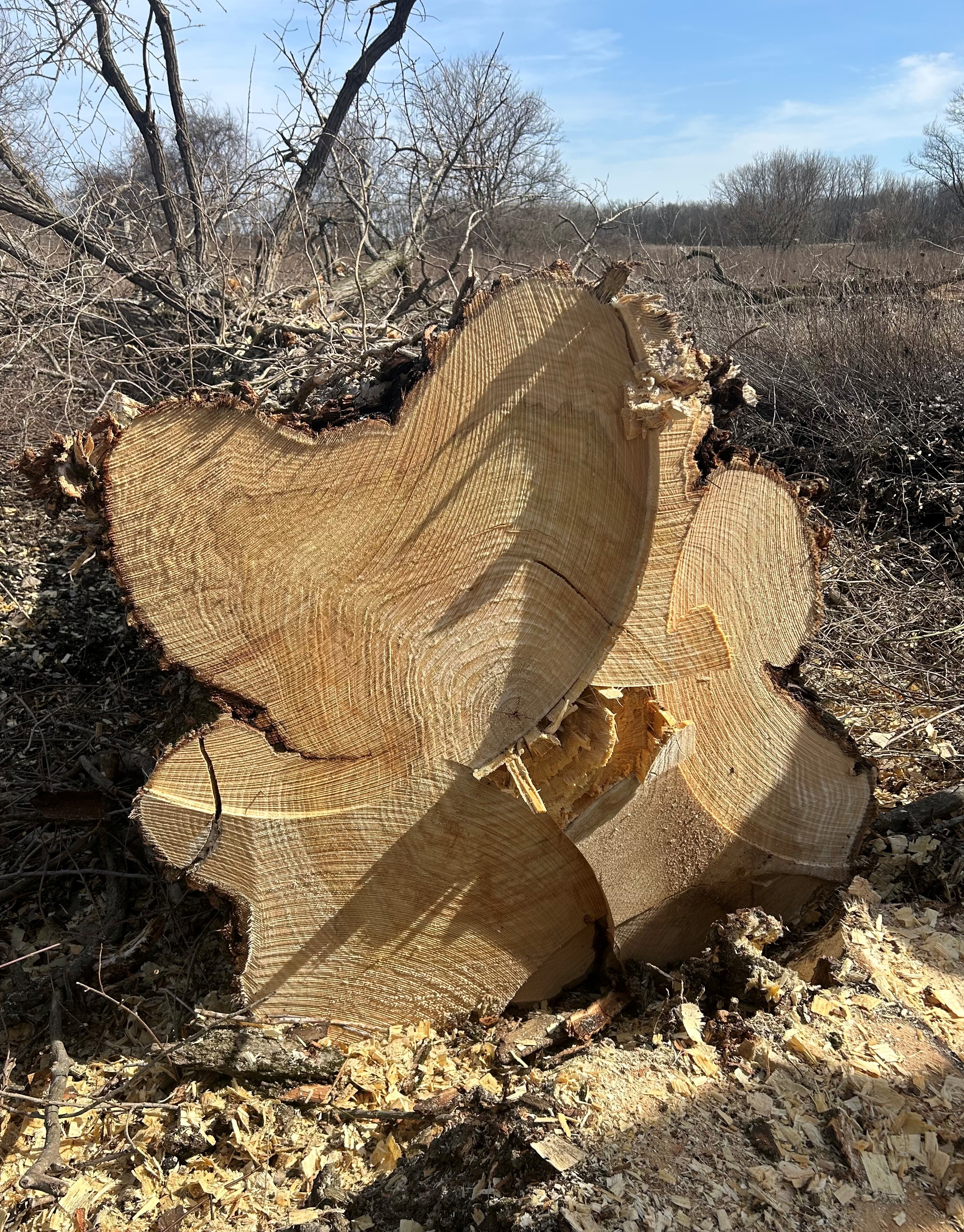
This too was listed as a positive last month, but an operator must know and operate within the buncher's limitations if he is to produce nice logs. The only way to know the buncher's limitations is by testing them occasionally. It is bad news when you find out that you can't quite get that big tree cut off and end up splitting it!
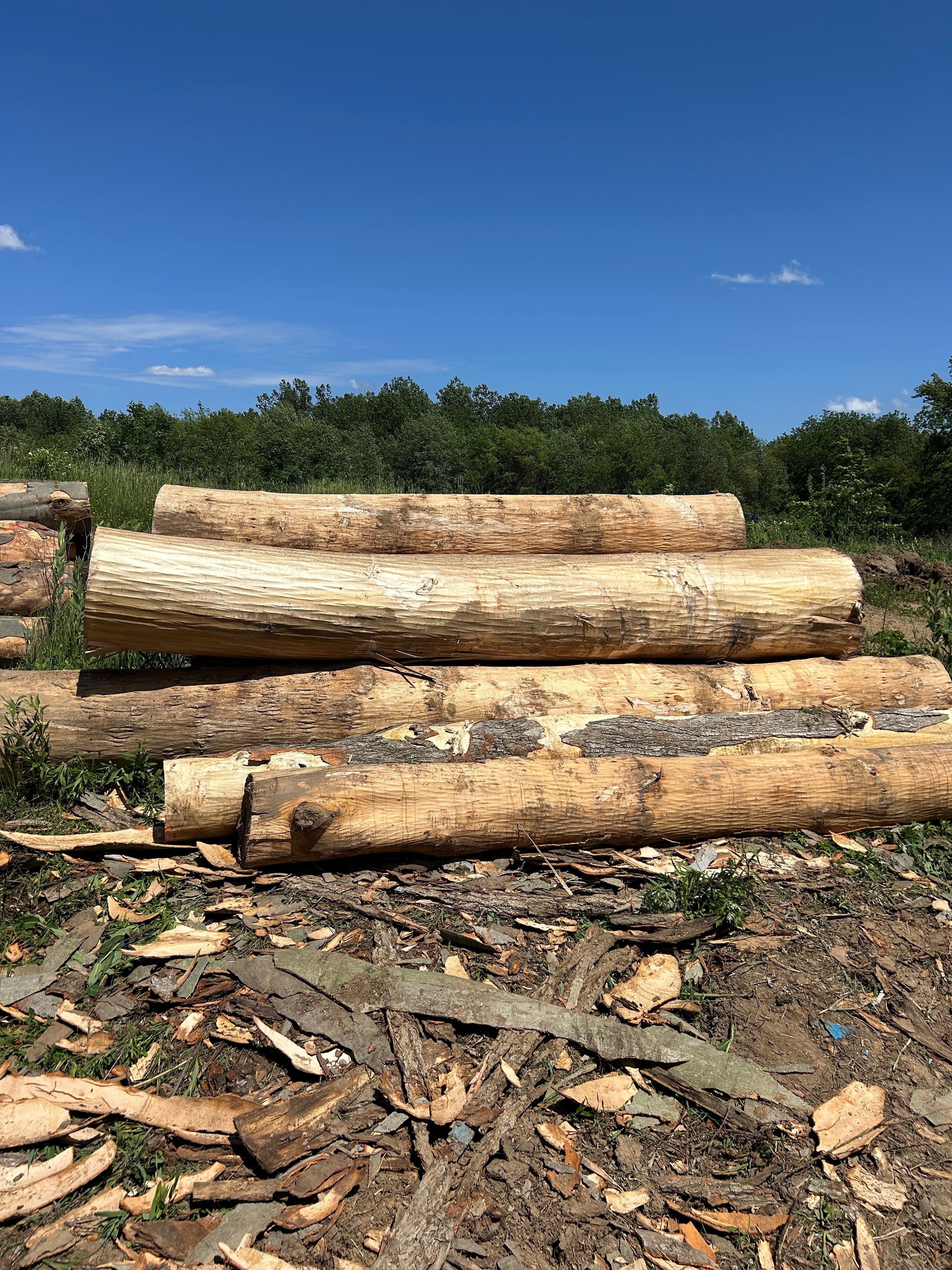
Mechanical cutting removes more bark from the logs than hand cutting. This is especially true during the spring and summer months when the tree is growing, and the bark is loose. Bark is a sawmill by-product, so it may seem efficient to leave it at the woods instead of hauling that extra weight to the mill. But bark is like a protective skin that keeps the wood from drying and cracking; therefore, it is better left on.
Veneer logs are likely to sell better when the bark is intact; even if they are fresh, they simply look more attractive with the bark on.
A friend told me that when chainsaws first came on the scene, his grandfather lamented about how much wood was wasted due to the wider chainsaw kerf compared to crosscut saws. Imagine what his grandfather would say if he saw the kerf carved out by a Quadco! While a 1¾" kerf at the stump and at the top is not terribly significant, it is wasted wood.
Multi-Stemmed Trees
Last month, I said that a benefit of mechanical cutting is the ability to fell multi-stemmed trees into a single opening. This is true, but is possible only up to a certain size. Big doubles and triples are difficult to cut since you cannot access them from both the front and back. Sometimes it is necessary to hand cut the first half of a double, which is fun since there is nearly always dirt or coons—or both—between the two halves.
Mental Fatigue
Hand cutting causes physical fatigue while mechanical cutting causes mental exhaustion. This may be hard to understand, but I think it has to do with the number of decisions an operator is making in a day's time. A good operator must be alert and constantly scrutinizing his surroundings to be efficient and careful. When you cut twice as many trees per day, you must make at least twice as many decisions per day.
Transportation
Moving a 75,000-lb. machine from job to job is challenging and can be a headache due to its oversize, overweight, and over-height load. Indiana and Michigan require single-trip permits for each move over state roads or US highways. These permits are not too expensive, but they are route specific and need state approval. Road construction and road closures are especially problematic during the summer, often requiring a circuitous route. With a gross weight of 125,000 lbs., I am maxed out on allowable axle weight with a three-axle tractor and a tri-axle lowboy.
I prefer to move equipment myself so that I can move when I need to, although navigating narrow back roads, especially if traffic is heavy, is stressful. It's often impossible to get the lowboy off the road to unload equipment. I sometimes lay out tire sidewalls to save the asphalt from track damage, but it's not always 100% effective. In short, transporting a buncher is significantly more complicated and more expensive than transporting chainsaws.
I have tried to be open about the pros and cons of mechanical cutting as I've experienced them. I acknowledge that methods and conditions vary considerably across the country, and I'm sure there are some aspects I have not experienced or may have forgotten to include. While mechanical harvesting has worked well for us, it is not the proverbial "silver bullet."
Ethan Royer, of Royer Logging, lives with his family in northern Indiana and provides logging services in northern Indiana and southern Michigan. He can be reached at 574.849.0867.
This article was originally published in Plain Communities Business Exchange (PCBE). Reprinted with permission. To subscribe to PCBE, call (717) 362-1118 or visit https://pcbemagazine.com