


By Benuel Esh
Several weeks ago we participated in a Logger Rescue Training with our local Fire & Ambulance Company. The training occurred on one of our active logging sites. We had two victims. One was a live victim with supposedly a deep cut to his leg (the makeup looked real, complete with red fluid that was oozing out of the wound). The other was a manikin pinned under a tree.
One of the EMS guys and I, along with the feller buncher operator assisting, set up the scene while the crew was on break. Both victims were about 300 yards from the landing, some hidden by branches and logging debris. They were about one hundred yards apart.

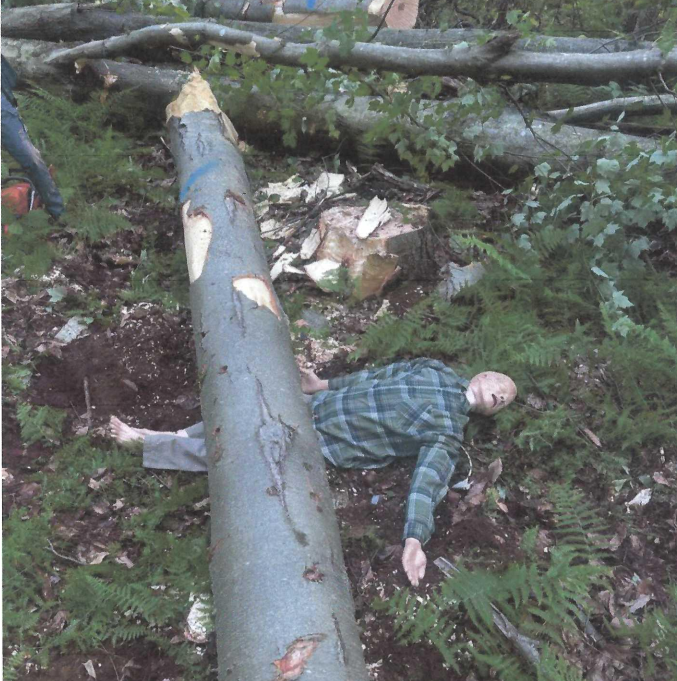
We then signaled the logging crew to start with the rescue effort as if one of the victims called for help. Some of the crew members went to search for the victims while someone else called one of the EMS guys acting as a 911 dispatcher (we provided his cell number prior). The EMS guy then radioed the fire and ambulance crews with a private channel. Meanwhile, once the crew located the victims, they worked on improving access to the victims and also provided directions and assistance to the first responders.
After the victims were extracted, we attended the debriefing at the fire hall. Following are some of the things we learned...
(A) Ideally, the person calling for help should be able to provide the municipality the accident happened in, along with the complete address and the nearest intersections on each end of the road where the scene is. Crew members should have all that information on their job spec sheet.
(B) If possible, someone should take charge of the situation.
(C) When one of the logging crew located the victim with the cut, they applied a makeshift tourniquet, then left him alone and focused on the manikin victim. We were told you should never leave a victim by himself unless it is absolutely necessary.
(D) Never attempt to lift the object off the person that is pinned unless it is done within a minute. They explained that a type of acid can build up that needs to be treated with medication prior to the victim being released from the object, otherwise the victim could go into shock or cardiac arrest.
(E) Any type of rescue or emergency situation is subjected to confusion. Radios tend to fail, directions can get confused, etc.
Overall, the training was a success. The logging crew actually enjoyed it and the fire company expressed gratitude for providing the opportunity. Consider contacting your local fire company to set up a training for your area and normal operations.
My biggest fear is a botched rescue. Not necessarily just as a result of the logging crew, but the first responders as well. They, after all, are only human, performing a rescue in a hostile environment.