


By Ethan Royer
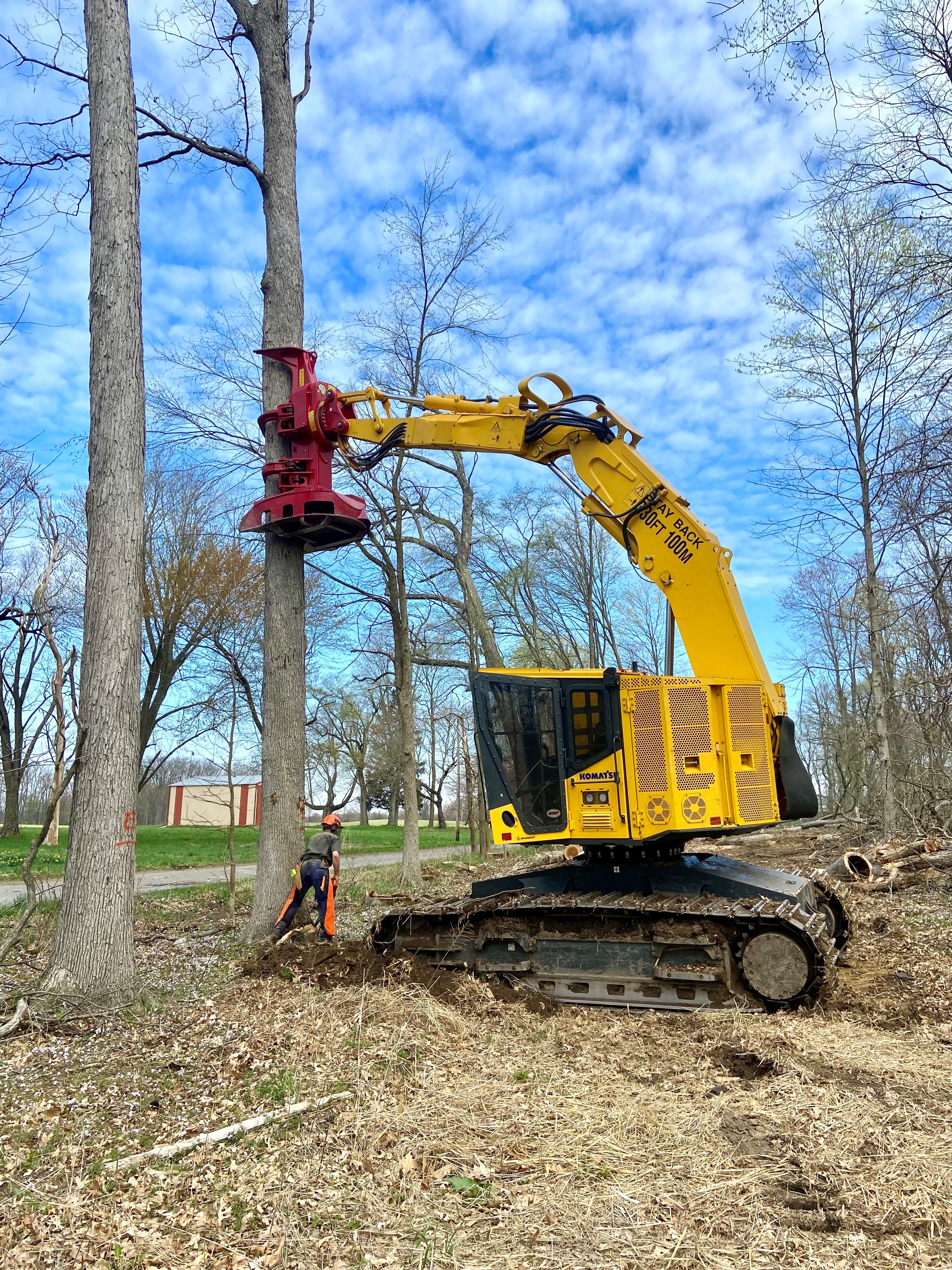
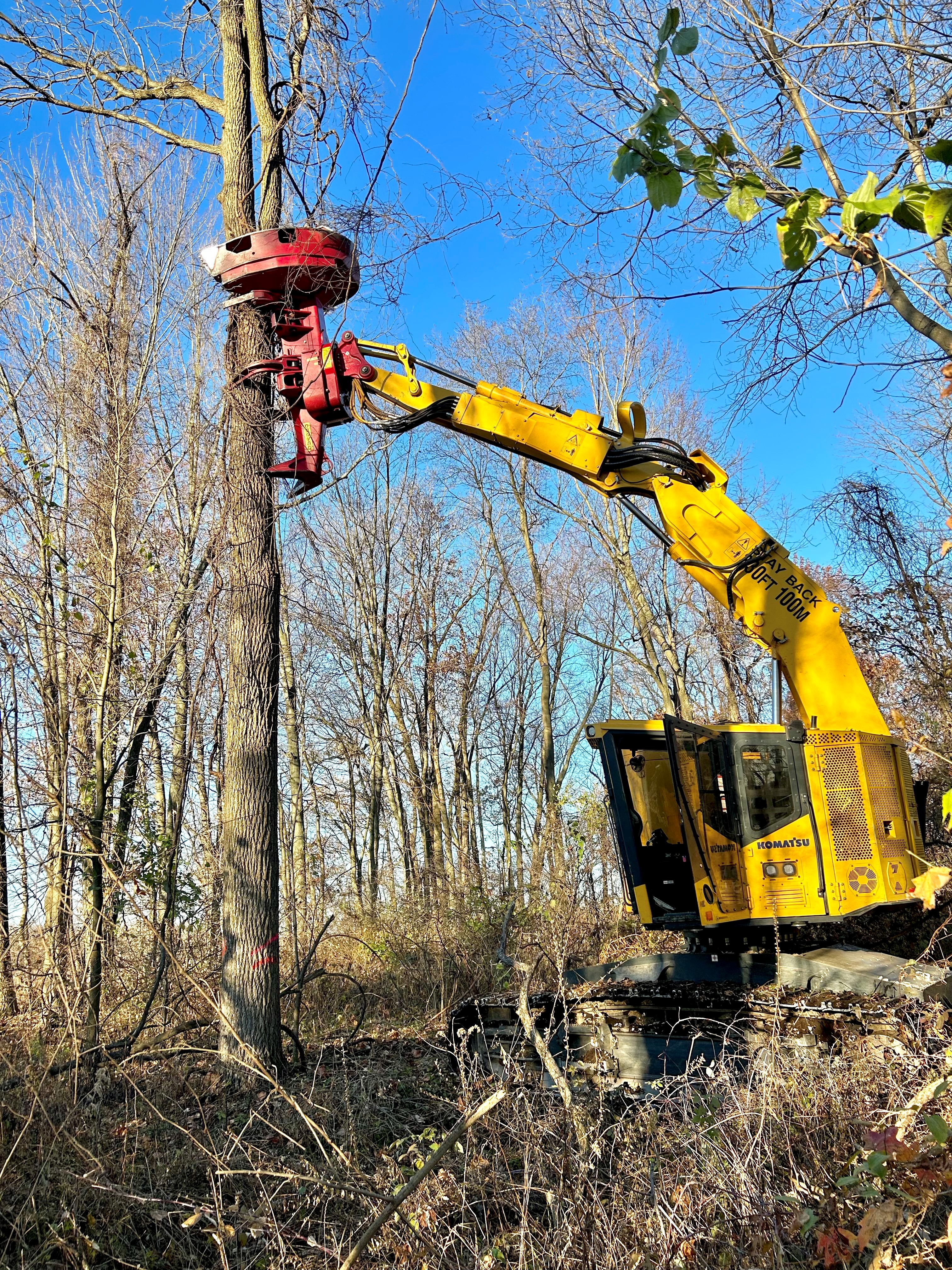
Last month, I discussed our venture into mechanical harvesting. This month, I want to go into detail on the benefits we've found with this harvesting method. To refresh your memory and provide context, we are using a Komatsu 430-5 feller-buncher with a Quadco 2900 intermittent disc saw to cut, limb, and top. We shifted away from hand cutting about seven years ago, but we still buck and trim logs in the landing with a chainsaw.
I will admit up front that I am biased toward mechanical cutting, though at one point, I was biased against it. I do acknowledge that my opinions on this are based almost entirely on my personal experience, and very likely there are others with different experiences or observations that will disagree with some of my conclusions. I've seen ugly jobs that were hand-cut and ugly jobs that were buncher-cut; so much depends on the conscience, expertise, and experience of the operator as well as jobsite conditions.
Safety
Everyone knows a logger who was killed or at least injured. If you didn't know of anyone before, let me introduce myself to you. I, Ethan Royer, broke my leg just above the ankle thirteen years ago while hand felling. I feel fortunate that it was my leg because the dead Elm narrowly missed my head.
While there have always been plenty of hazards in the woods, Missouri-based logging safety instructor, Joe Glenn, says he feels that there are more hazards in the woods today than ever before. We have dead Elm due to Dutch Elm Disease, dead Ash due to Emerald Ash Borer, many other hollow and rotten trees due to decades of mismanagement, pasturing, and high-grading, and a host of invasive shrubs (such as Japanese Honeysuckle and Autumn Olive) that impede sight and mobility.
Mechanical cutting is safer and less physically demanding. Now I don't fall asleep when I sit down after supper the way I did after a day of hand-cutting. While I seldom work alone, I can and occasionally do now that I'm safely behind a 1¼-inch Lexan window.
Tree control
I believe that tree control is a game-changing benefit of mechanical cutting. When we were hand cutting, we had added a pusher onto the back of the skidder and did a lot of pushing, but lean was still a big factor in deciding which direction to fell a tree. While there are big trees or heavy leaners that are beyond a buncher's ability to handle, in most cases, it doesn't matter which way a tree leans, you can direct it into the best available opening.
Think of a double or triple stemmed tree. Usually each stem leans a different direction, but with a buncher, they can often be felled within a single opening. The ability to manipulate trees to avoid damage to the surrounding stand is the biggest reason why I feel we can do a better-quality job with mechanical cutting. At first glance to the untrained eye, the collateral damage may not appear much different; it's just that we can choose to save a White Oak at the expense of an Ironwood. A big machine smashes more 1- to 2-inch trees but saves more of the medium trees that are most likely to make it to maturity.
We still hand-cut occasional small jobs, but I honestly feel that there is a bit more collateral damage than with machine cutting. When hand-cutting, it is possible to take extra effort to fell trees the opposite direction from the lean, but it requires a push from the skidder or beating wedges. Beating wedges might be good batting practice, but it is exhausting. We are more apt to do careful work when it doesn't require extreme physical exertion.
Horse-logging is often promoted as being best for the woods, but I beg to disagree. True, there will be less skidding damage than with a skidder, but you are very limited in directional felling with no machine to direct trees. I know of a logger (he owns horses) who was skeptical of feller bunchers only a couple years ago. He recently told me that he logged his own woods and used his feller buncher to do the least amount of damage.
There are numerous little tricks to minimize collateral damage. If trees have a low fork (up to about 20 feet), it is possible to reach up and cut them separately prior to cutting the trunk. This takes a bit of extra time but causes less damage than felling the whole tree. In tight quarters, a tree (with or without a fork) can be topped at 20 feet. This reduces the weight and allows the top to be laid down near the stump.
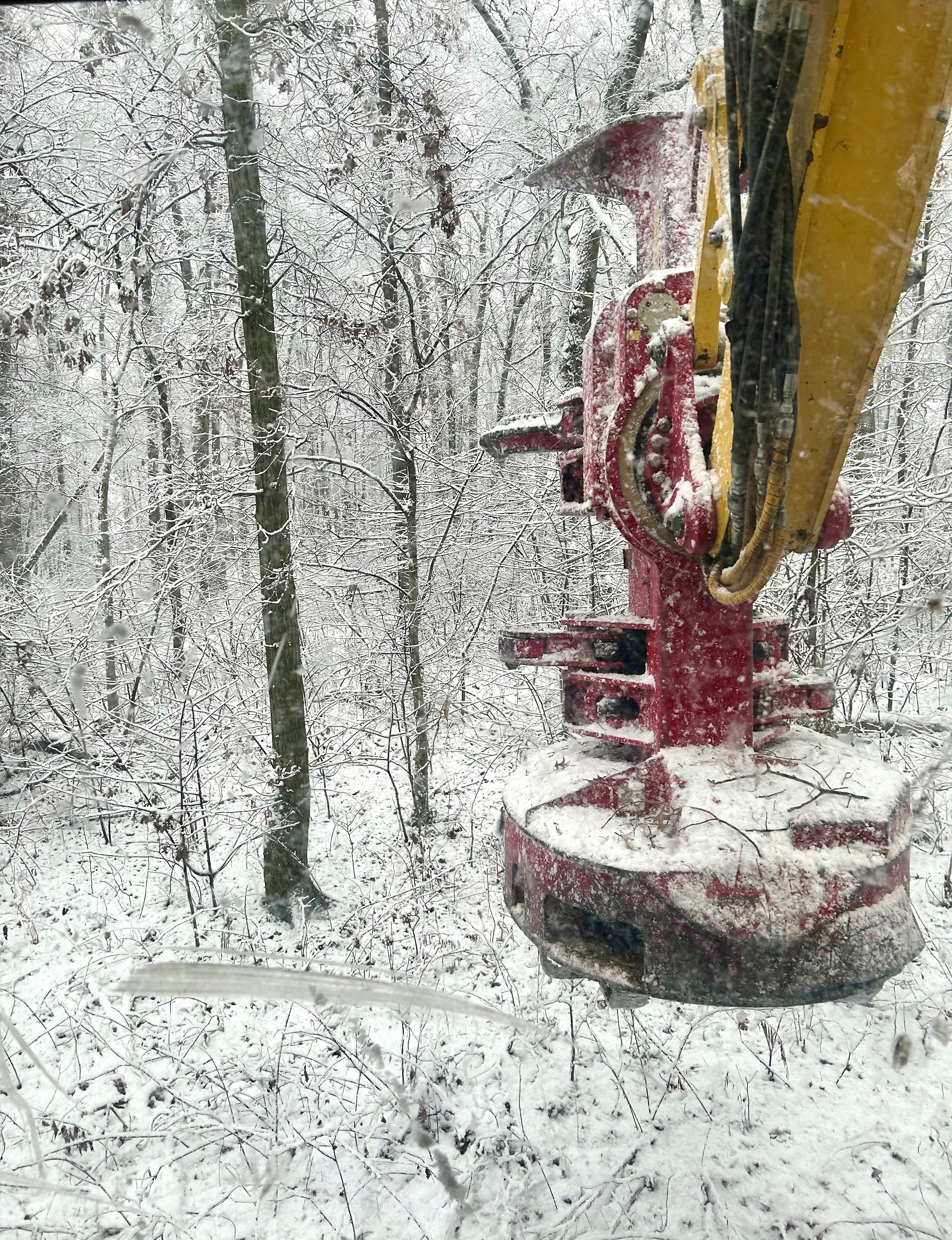
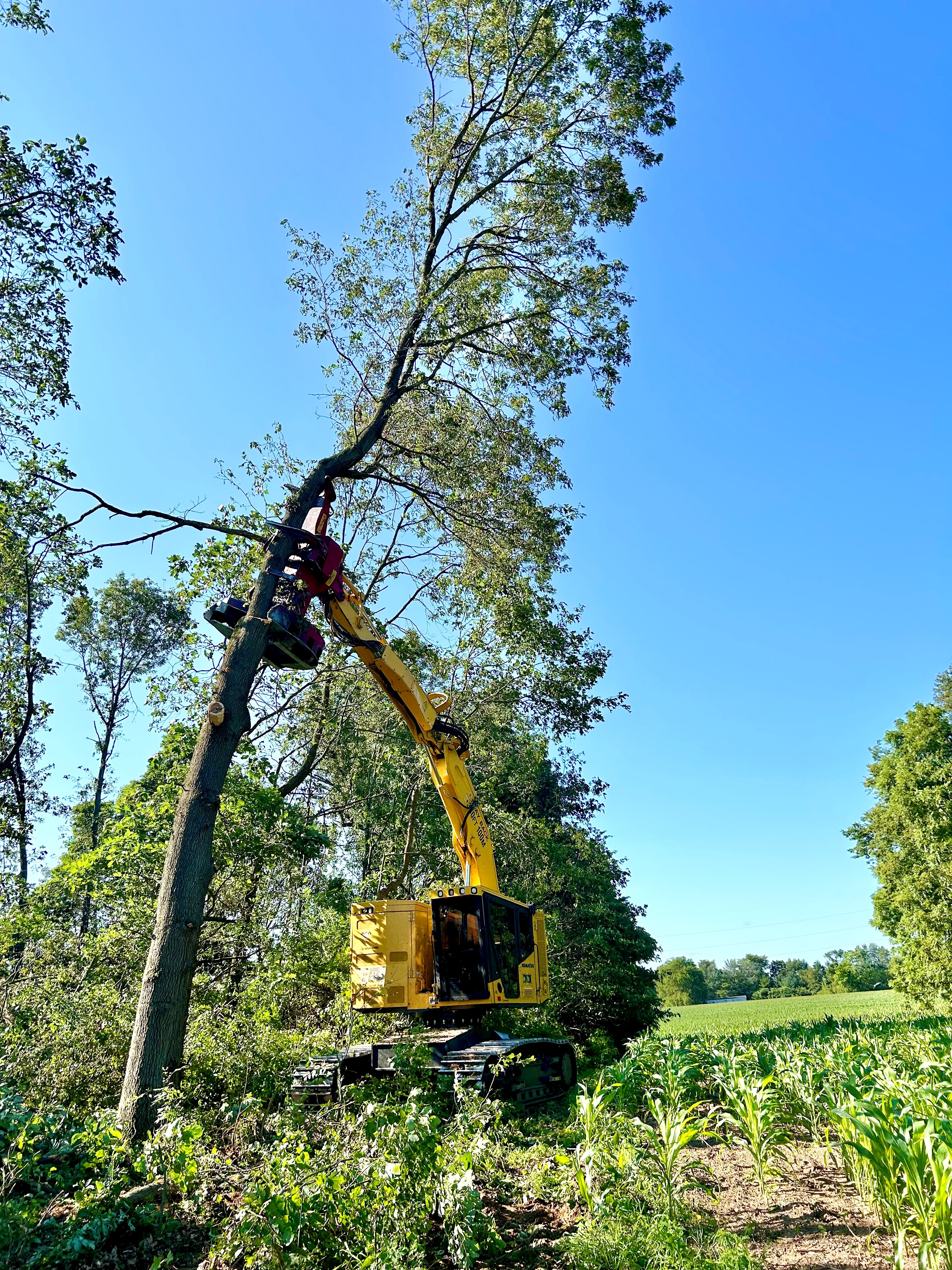
Another trick is to sweep the butt back as the tree is falling. This keeps it from reaching out as far and significantly reduces the odds of breaking smaller trees brushed by the falling tree. As the top arcs downward, the outstretched limbs catch on smaller trees and bend them, but if the falling tree is yanked back, the limbs ride down the sapling (sometimes skinning it) instead of breaking the trunk. Perhaps this is hard to visualize, but I've found it makes a big difference in collateral damage if the butt can be swept back even 10 feet.
In a tight woods, small to medium trees can be cut and carried vertically to a place where there is space to lay them down. If there is no opening, and a tree gets hung up, using a buncher to simultaneously lift and pull the tree is less damaging than merely yanking it down with a skidder. All this results in less damage to the residual stand and makes for a cleaner job.
In certain situations, we will hand-cut trees and use the buncher to push or pull them. Big trees leaning over a road, fence, building, or powerline are good candidates for this. With a 75,000-pound machine and the ability to push or pull 30 feet up the trunk, it is more feasible than pushing or pulling with a skidder. It's also safer than perching on the arch of the skidder to throw a choker around the trunk; Dad once fell off while doing that.
Pushing works best but requires sitting behind the tree, which is not always an option. Pulling can work well too, but only on trees that fit in the arms on the head. Since bunchers have relatively little swing torque, you have to pull from essentially the same spot where the tree is supposed to fall. Then as you begin pulling by backing up, you have to swing the tree down beside you. This works well enough to make trees fall where you want, but it's very difficult to do it without splitting the hinge since you must simultaneously pull and twist the tree. We are still experimenting with this method and have not yet found a failproof solution.
Manipulating trees comes in handy for blowdown timber. For wind-thrown trees, we usually top them first, then reposition them vertically before cutting it at the stump. This makes for cleaner look since the root wad ends up back in its hole. Cutting dirt is unavoidable in downed timber, but Quadco saw teeth can handle a lot more dirt and gravel than chainsaw chains.
Forestry
Forestry best practices are constantly evolving as research sheds new light on what methods yield the most favorable results. A current management method is cutting group selection openings. This consists of marking all trees in a small area to make a sunny opening that promotes regeneration. Mechanical harvesting is helpful in making the most of these openings since you can generally make all surrounding timber fall into this opening. This not only prevents damaging the surrounding stand, but it also helps smash everything within the opening, making less work for the forester who later completes the opening.
A local forester has said the extra soil disturbance caused by maneuvering a track machine promotes regeneration by exposing bare soil, allowing seed-to-soil contact. We once cut a job during October when the acorns were falling, and the same forester later reported phenomenal oak regeneration, but as they say, “Timing is everything.”
Production
Increased production is an undisputed advantage of mechanical cutting. Obviously, if a buncher did not increase production, it would not pay for itself. In our case, we run a two-man crew the same as we did when hand-cutting, and we produce about double the footage per cutting hour. However, I do not think annual production doubled since we now must spend more time marking and bucking that extra volume.
We are typically producing 3,500 to 4,500 board feet per hour. I've found it surprisingly consistent. A terrible job may get as low as 3,000 feet per hour, and a great job may reach 5,000 feet per hour, but those are outliers. For readers unaccustomed to Doyle scale, a semi load of logs (80,000 to 85,000 pounds gross) typically scales between 3,250 and 4,000 feet.
I've noticed increased uptime over hand cutting: we don't need to stop working if it's windy, or if we're half sick. A couple of years ago, the skidder operator and I both had Covid the same week. We did not feel well enough to swing a chainsaw, but we quarantined in our cabs and continued producing all week despite the misery. Some time ago, I had a surgery and was able to return to work long before strenuous activity was allowed.
Higher production allows us to take greater advantage of brief windows of favorable weather. Once we were trying to knock out a river-bottom job before rain arrived the following day. We started around 6:00 in the morning and worked until about 9:00 that night, producing an estimated 50,000-plus feet in difficult conditions. A 15-hour day is simply not possible (at least not safely) when hand cutting in August heat, but a machine doesn't get tired and can produce at full speed all day.
Our equipment is not subsidized with timber value or sawmill profits. We are making it work based on custom logging production, and our logging rates are in line with area norms.
Skidding Assistance
Mechanical harvesting improves skidding by moving the trees into the open and piling them together to form a skid. This allows the skidder to handle more board feet per hour and reduces damage to the remaining stand. Although mechanical cutting does not always permit working in wetter conditions than hand cutting, it is helpful for crossing a few wet areas on otherwise dry sites. The buncher can create corduroy road, lay brush in the trail, and help install mats or bridges as well as shovel logs to higher ground where the skidder can access them.
Landowner Perceptions
When we made the change to mechanical cutting, there was no one else doing it in northern Indiana. We feared that some landowners would not allow or appreciate a big machine in their woods. Those fears were unfounded. It actually increases landowner confidence when the logging crew shows up with expensive equipment because they perceive it is not a fly-by-night operation.
One landowner said, “I wasn't too sure when I saw that machine roll in, but after watching, I can see you are using it to minimize damage to the remaining trees.”
To the best of my knowledge, not a single landowner has been displeased with our cutting method since we switched seven years ago. Landowners appreciate quick completion of the job rather than intruding on their property for a long time.
I often wish the buncher had a buddy seat. It would be educational to have the owner along so I could explain what I'm doing and why. A few people have asked for rides, but I must decline unless they are small children; there is simply not room for two adults. The best I can do is talk to them over the phone through my headset while they watch from a safe distance.
Value-Added Options
In some cases, having a buncher adds value. We work a disproportionately high number of blowdown jobs since it's safer, easier, and more productive with a buncher. A forester recently negotiated a timber sale contingent on us doing it with a buncher because the roadside trees were large and difficult or impossible to pull with a skidder. Depending on the scenario, we use various techniques to maintain better log quality.
I mentioned earlier that I can cut low-forked trees by cutting the stems individually; this eliminates the risk of splitting the butt log. If the crotch is too high to reach, I can turn the head upside down and reach up to about 30 feet and score the crotch so it will split the top log instead of the trunk when it falls. On a high-dollar Walnut that has a split-prone crotch too high to reach, we may hand cut it while holding it up high with the buncher, then lay it down gently so it won't split.
Since logging is our bread and butter, we give it priority, but we've done a number of fencerow or ditch bank clearing jobs when time allows. The ditch authorities do not approve of digging stumps on ditch banks, so cutting them is the only option. A buncher works well for this since it can reach down the bank, cut the trees, and pile or windrow them away from the ditch. On fencerows, the whole tree can be ripped out with an excavator, but in some cases, it is more efficient to cut the trees and lay them out perpendicular to the fencerow so they can be easily pushed together. The rotating head gives the buncher an advantage over an excavator for handling and organizing brush.
Wait until next month to ridicule the points presented here. As the saying goes, “If it sounds too good to be true, it probably is.” Next month, we will consider some downsides to mechanical harvesting. Some of the positives listed above will also be included in the negatives next month. There is a balance in most things, and too much of a good thing can become a bad thing.
Ethan Royer, of Royer Logging, lives with his family in northern Indiana and provides logging services in northern Indiana and southern Michigan. He can be reached at 574.849.0867.
This article was originally published in Plain Communities Business Exchange (PCBE). Reprinted with permission. To subscribe to PCBE, call (717) 362-1118 or visit https://pcbemagazine.com