


By Ethan Royer
This month I will begin to detail our transition from hand-felling to mechanical harvesting. I understand this can be a controversial issue; we all tend to think that how we do things is the best way. I have found that almost all hand cutters are skeptical that quality work can be achieved via mechanical cutting.
These articles may sound as though I'm trying to sell you a feller-buncher, but I am not here to tell you that you should do as we've done or that our methods will even work in your situation. However, I do believe that traditional hand crews often harbor some misconceptions about mechanical harvesting—I know I did. I hope to go into detail about what we have discovered and some blunders we made along the way.
There are pros and cons to every method; there is no given method that is the best in all situations. While mechanical harvesting is becoming more common almost everywhere, there will always be a place for good hand crews. I hand-cut for more years than I've machine cut, and we still hand-cut an occasional job. I've not yet tired of standing there with a saw in hand, watching a tree fall. In my opinion the best quality work can be achieved with a combination of hand and mechanical cutting.
Hand-felling is hard work. If you think manual labor is a man’s name instead of an activity, this job is not for you. I am not yet old, but gone are the days when I could swing a Stihl MS 661 all day and still have energy to play volleyball in the evening. This strenuous work tends to force men into other careers as they age. My father would've liked to continue working in the woods longer than he was able to, which made mechanical harvesting sound appealing.
Strike One
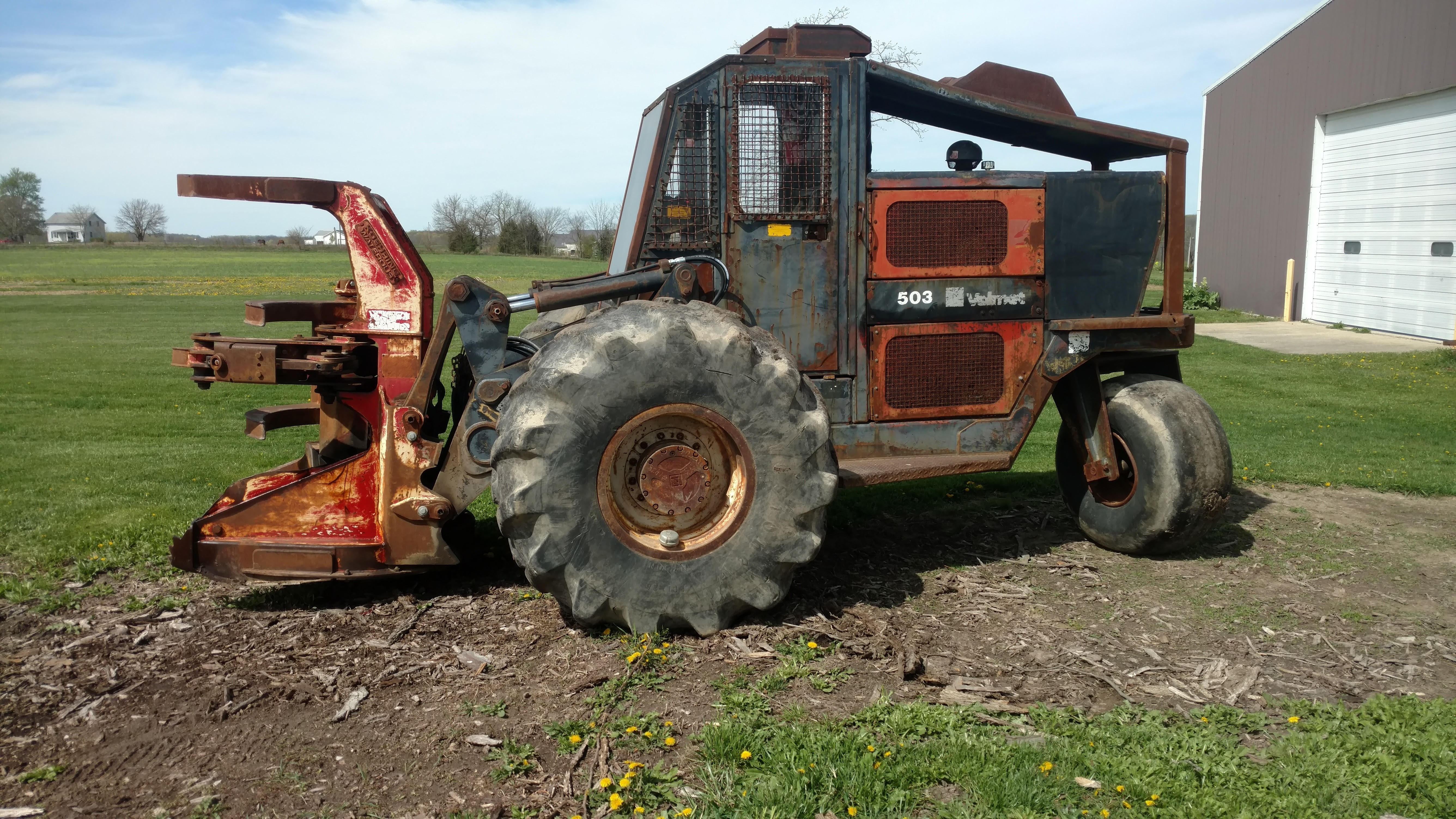
Some years ago, Dad had a vision of getting into mechanical harvesting and purchased a worn-out Valmet 503 as a low-cost experiment. It was one of those three-wheeled machines made popular by the Bell brand. It had an 18” hot saw that we knew was inadequate for much of our timber, but we thought it might work on clearcuts with smaller trees. We soon concluded that while it may have worked well in a pine plantation, it did not do what we needed. Even a small hardwood tree would tip it on its nose!
Admittedly, we never maximized it's potential. I'm sure a good operator could've done better, but we couldn't envision it performing to our satisfaction, so it was sold. While it was a failed experiment, we were impressed with how fast it could cut through a tree.
The Seed Is Planted
In May 2017, the Indiana DNR division of forestry held a forestry field day in southern Indiana for the purpose of showcasing mechanical harvesting. Dad and I attended the event, which included discussion about machine specs, pros and cons of mechanical harvesting, and a live in-woods demonstration. Before this, I had never seriously considered mechanical harvesting, primarily because I was unaware that there were any saw heads that could handle the large hardwoods we work with. Ignorance is bliss while it lasts.
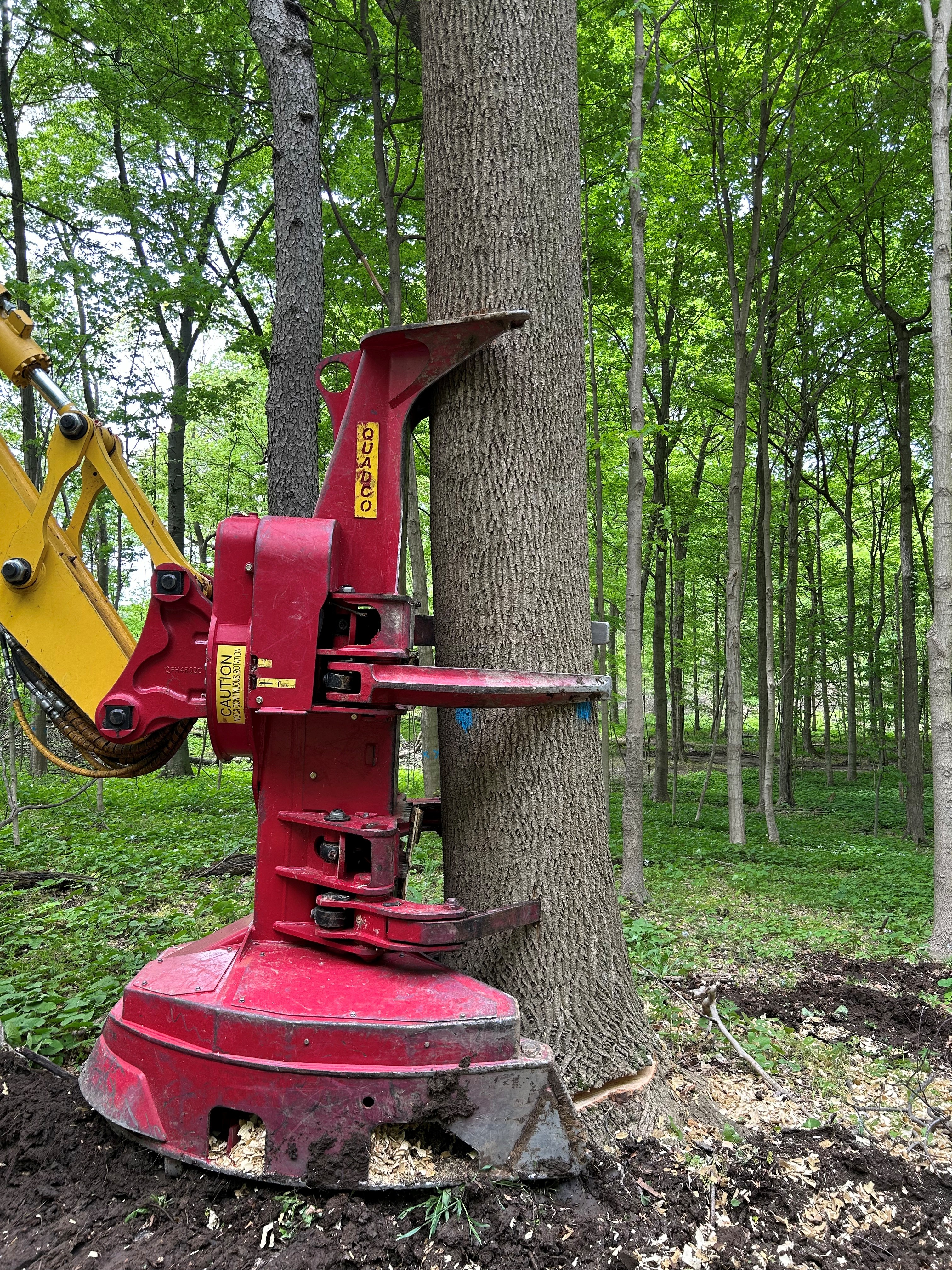
At this event, a Komatsu XT460-3 and a Tigercat LX830D feller-buncher were on display, both with Quadco 2900 intermittent disc saws. At that time, there were no mechanical crews in northern Indiana, and I'd never seen any cutting attachments other than hot saws and processing heads. I now know that there are a number of other felling heads for big timber (most utilize bar saws), but I have not observed any in action.
This field day took away my belief that there were no heads capable of handling large hardwoods, but I was still not immediately convinced to buy a feller-buncher. In fact, on the three-hour drive home, we talked about all the reasons why it wouldn't be a good method for us. However, the seed was planted, and eventually it began to grow on me that there may be more than one good way to harvest timber. One thing that hastened our decision to try mechanical harvesting was that we were growing weary of doing clearcuts by hand. We don't do a high percentage of clearcut jobs, but we'd had a rash of them about that time. So, without any swimming lessons, I dove in!
Strike Two
The trouble with pioneering any new thing is that there is no one to ask for advice, and you inevitably make rookie mistakes. I'm sure there were people who could've given good advice on this transition process, but I didn't know who they were or even what questions to ask. As I looked at machines, it became apparent that Quadco 2900 heads are rare, and few machines on the market come with one installed. I was able to locate a used Quadco 2900 on the west coast and purchased it.
Then I bought an older but low-hour John Deere 753J with a 20” hot saw in Louisiana and had it hauled here. I took it to a local heavy equipment mechanic shop that had agreed to remove the hot saw and install and plumb the Quadco. They told me to get the specs for them and they would do the work. After doing some research I was informed that the Deere 753J did not have big enough pumps to generate the 90 GPM flow required to operate the Quadco intermittent head. (Hot saws rely on momentum instead of torque and only require about 35 GPM.) This seemed like an insurmountable hurdle, so we used it with the factory hot saw on a couple of jobs and sold it for a loss.
As someone once said about a business idea that failed, “It was almost as good as a college education and cost just as much.” Education is sometimes expensive, but in retrospect, I'm glad that machine didn't work out. It was too small and unstable, and it had 36” triple grouser track pads that were good for flotation but were helpless in snow or hills. While this was another strike, we did use the Deere on a couple of jobs and, despite the less-than-ideal setup, we thought we saw potential in mechanical cutting. A mistake isn't failure unless you don't learn from it.
Score!
After selling the Deere, I bought a used Komatsu 430-3 from Roland Machinery in Wisconsin. This model is Komatsu’s only non-leveling buncher (In our flat ground, we don't need leveling). This non-leveling model has a slightly longer undercarriage than the leveling models, increasing stability and flotation. A leveling machine would have some advantages even in our flat terrain, but I feel the extra cost, weight, and maintenance outweigh the benefits. It came with 28" double grouser track pads which are a good fit for our region. We purchased it with no head and hauled our 2900 up there for them to install. Quadco is owned by Komatsu, so we figured they should be able to make it work.
When they were done, they delivered it directly to our jobsite, and it worked well with no need for further adjustments. I, on the other hand, had to make a lot of adjustments! The standard operating procedure the first while went something like this: think what I wanted to do, push joystick the wrong way with a jerk, push joystick the other way with a jerk, push wrong button, groan, push correct button, split tree, lurch forward, lurch backward, sigh… and so on.
It had to be painful to watch, and it was literally painful to operate—my wife had to rub the kinks out of my tense shoulders in the evening while I complained that this was supposed to be easier than hand cutting! Fortunately, we were cutting a pallet job, because there was a fair bit of wood wasted.
I am not necessarily partial to Komatsu; it's just what I stumbled across. Both my original 430-3 and Roland Machinery served me well. In 2021, I purchased a new Komatsu 430-5 from local dealer Brandeis Machinery. I believe there are other brands that are equal or even superior, but a previous positive experience with Komatsu and good local service were deciding factors. Feller-bunchers are complex machines that will inevitably have issues, so responsive service is key.
Tree Hugger
While a Quadco 2900 is a felling head, we use it for limbing and topping as well. It can be a bit tedious on limby trees but works fairly well. It can cut off limbs flush with the trunk, but it takes time. Sometimes it is more efficient to knock off knots or small limbs with a chainsaw in the landing. It rotates 360 degrees, making topping easier. While many people are familiar with hot saws, intermittent disc saws are far less common and operate differently. I'm not aware of any similarly designed head; I understand that Quadco has the design patented.
It is known as a full-control head: you grab the tree before you begin cutting; whereas, you have to simultaneously cut and grab with a hot saw. It is still a circular saw with the same tooth style as hot saws but with a narrower 1.75” kerf. Hot saws cut fast and are simple, but a downside is that you can cut less than half the blade diameter.
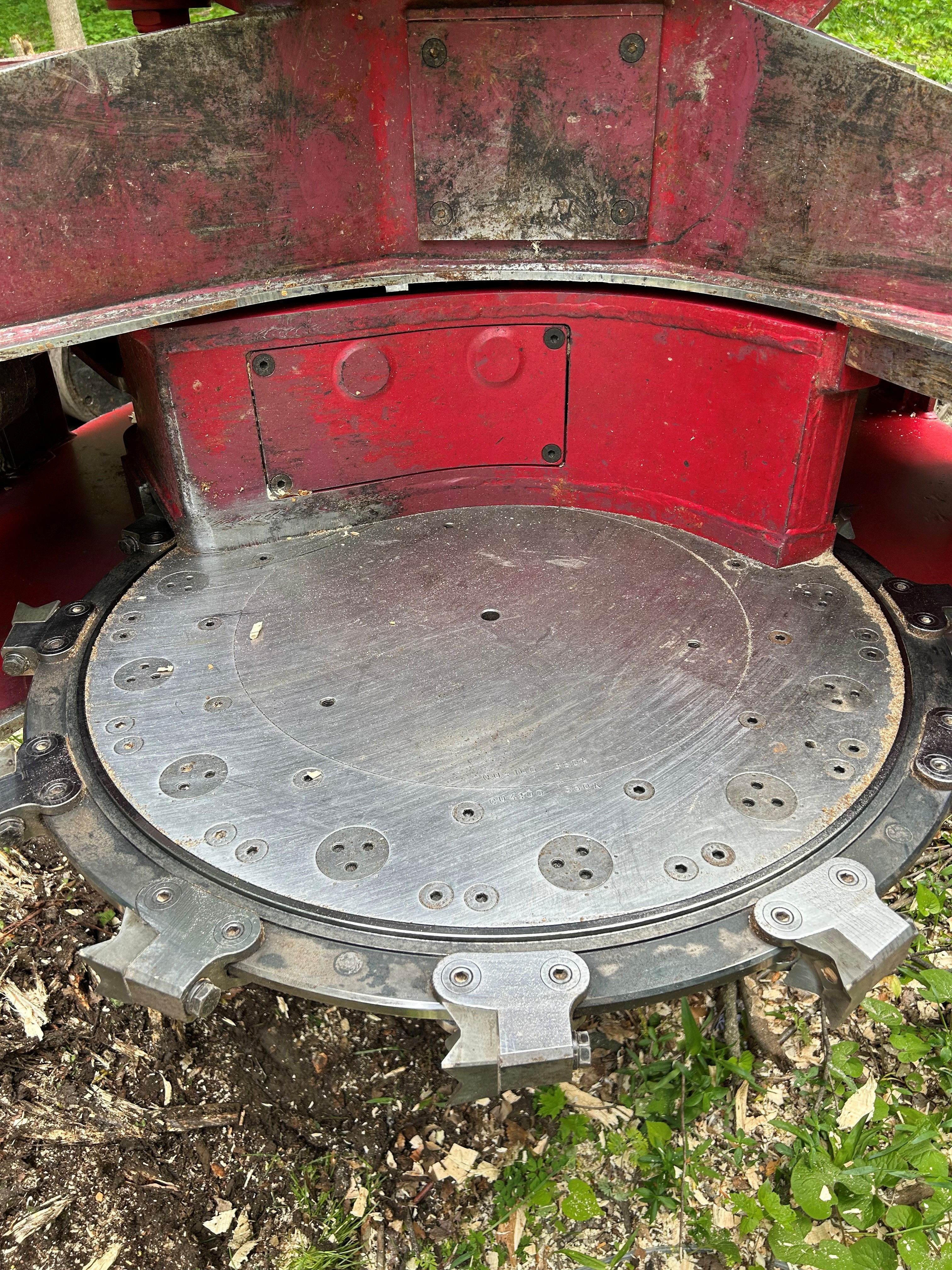
With an intermittent disc saw you can cut well over half the diameter of the disc since it is a ring saw: only the outer ring spins, allowing the disc to be held near the edge. The saw ring has gear teeth on the inside, allowing it to be driven by a pair of 75 HP hydraulic motors. By pushing a single button, the saw is activated and then automatically extends into the tree. Releasing the button retracts and stops the saw, hence the intermittent moniker. With a 29”-cut capacity, it handles most of our timber; although most trees must be cut from two or more sides.
While they are slower and higher maintenance than a hot saw, full-control heads are more capable and versatile. It is safer to be able to completely hold the tree prior to cutting, especially near fences, buildings, or powerlines. Shoveling logs is also easier with no spinning saw in the way.
Admittedly, I have zero experience with bar and chain style heads, but my opinion is that they require more maintenance and are more difficult to use in big timber without pinching bars, bending bars, and throwing chains. I have bent the saw ring a couple of times, but a local shop has been able to straighten it. This head is about 9’ tall, which gives a lot of leverage to push trees that lean the wrong way. I was initially worried that this type of head would be difficult to maintain or would need frequent repairs, but I've had two, and they've proven to be robust and relatively easy to maintain. They are a tree-hugger I approve of.
Growing Pains
When we switched to mechanical cutting, we ended up overhauling the entire operation; although it didn't all happen immediately. We felt it was important to be able to transport the buncher ourselves instead of hiring it done, not because we enjoy it, or because it's necessarily cheaper, but because we can move when we need to. It's very difficult to predict several days in advance when a job will be finished, so scheduling a trucker is difficult and inevitably results in extra downtime.
This necessitated the purchase of a semi and tri-axle lowboy. Then due to increased production, our Deere 548GIII was unable to keep up with skidding, so we purchased a Tigercat 602. Now we have issues with small landings filling up fast, a battle we are still fighting. We recently purchased a Deere 437E knuckleboom loader to improve efficiency, especially in tight landings. Removing one bottleneck invariably creates one elsewhere.
In the next two articles I will continue this topic by going into detail on the pros and cons we've discovered about mechanical harvesting. I hope to show that while mechanical harvesting is not maniacal harvesting, neither is it a "silver bullet."
Ethan Royer, of Royer Logging, lives with his family in northern Indiana and provides logging services in northern Indiana and southern Michigan. He can be reached at 574.849.0867.
This article was originally published in Plain Communities Business Exchange (PCBE). Reprinted with permission. To subscribe to PCBE, call (717) 362-1118 or visit https://pcbemagazine.com