


By Ethan Royer
Proverbs 21:31b says, "The horse is prepared against the day of battle: but safety is of the Lord". Logging is dangerous work, and while we should be safety conscious, we do well to remember this verse. Throw any group of veteran loggers together, and tales of close calls and injuries abound. Praying for safety each morning is a good thing for several reasons: God hears and has the power to preserve us if He so wills, it is good for us to acknowledge that our lives are in His hands, and it reminds us to be careful.
We probably have varying opinions about what personal protective equipment (PPE) is necessary, but I think we can agree that it is foolish to pray for safety and then throw caution to the wind. Trust in God is not a substitute for carefulness. Timber cutters are still in a survival-of-the-fittest (or survival-of-the-safest) world: the genetics of those who chase-cut, jump-cut, or use other risky methods tend to be removed from the gene pool.
My friend Matthew Kenny says, "There are old loggers and there are bold loggers, but there are no old bold loggers." There is truth there. If you can't predict what a falling tree is going to do, then you had better be able to outrun it! That said, if your plan for the tree you are preparing to cut includes "run like a scalded cat as it's falling," then it is probably wiser to let it stand.
SAWW Training
About ten years ago, the state of Indiana began requiring SAWW certification for logging state land or classified forests. SAWW stands for “Safety and Woods Worker training.” While we encounter very few state sales, we often work in classified forests. Classified forests are private woodlots that are enrolled in a state program that gives a property tax break in exchange for properly managing their woods and harvesting timber periodically.
We had never taken training before and were reluctant to do so, but in order to comply with the new regulations, we began taking the required training. While I would not have admitted this at the time, I felt that after ten years of cutting experience, there wasn't much worth knowing that I didn't already know. Of course, I was wrong. I learned some valuable things from these courses, which we call "cutter training."
There are various SAWW training instructors around the country, but the only instructors I have experience with are Joe Glenn and Aaron Hovis from Missouri. They are real-life loggers, not inexperienced teachers with textbook answers. There are at least four levels of cutter training as well as storm damage and tree utilization courses. They teach the open-face bore-cutting method I was accustomed to, but they helped me understand the reasons for the method.
This training is not merely about safety; it also covers directional felling, log quality, production, and efficiency. The training is intended to teach skills that help a cutter be safer, more productive, and consequently more valuable to an employer. I would recommend it. I have learned from it, and it's good to do it periodically to get safety back to the front of my mind.
As mentioned, there are several levels of training classes suited to anyone from beginner to professional. They cover PPE basics like hard hat, chaps, hearing protection, and eye protection. I never knew plastic hard hats have an expiration date until I was informed in class. When hand cutting, I wear a hard hat with earmuffs (I don't like ear plugs), a face screen (earmuffs don't seal well with safety glasses), and chaps. I sometimes wear chaps when walking around in the woods, even if I'm not using a saw; they protect your pants and legs from briers, which also protects your attitude.
Proper saw maintenance and filing are included topics. Obviously, many skills (like saw filing) are not mastered by taking a class, but are skills that come with experience. However, having someone show the proper techniques can shorten the learning curve. In Levels 3 and 4, more difficult skills are taught: skills like spring-pole release, wedging, push/pull trees, and cutting trees with heavy lean. While this article cannot cover much of what is taught in those classes, I will mention a few things I learned from it.
Skill to Hew?
When King Solomon was preparing to build the temple, he sent to Hiram requesting timber and said, "For thou knowest that there is not among us any that can skill to hew timber like the Sidonians" (I Kings 5:6). I wish I could have seen the logging operations of the Sidonians. What superior skills did they have that the Jews did not? Was their timber drastically different than what the Jews were accustomed to? Could they not have taught their skills to the Jews? Since Solomon was the wisest man that ever lived, he surely had valid reasons for doing it the way he did. Perhaps he realized that by the time the Sidonians imparted their skills to the Jews, the temple would be built. Certainly, timber felling skill is not something that is acquired overnight but comes with experience.
Directional Felling
When logging a select-cut job, directional felling is a necessary component of quality work. I once heard a story about a city slicker visiting a logging job. As the logger sized up the tree he was about to cut, the city slicker fearfully asked, "Which direction is it going to fall?" The logger sized up the tree again and drawled rather unhelpfully, "It's gonna fall down!"
I worked with someone one day who appeared to be able to direct trees only in the direction of down, and the result was an ugly disaster. Unnecessarily smashing or skinning up-and-coming trees destroys value that takes years to grow back. I sometimes say, "We are paid by production, but hired by quality." While we are not directly compensated for directional felling and careful work, we will have trouble finding employment if we are careless.
Read the Stump
One thing I learned from SAWW training was how to read a stump after the tree has fallen. Was the hinge the thickness you thought it was? On a double-bore, did the two cuts line up? Did your cuts bypass at the apex of the notch? Did the hinge guide the tree where it was aimed and then break cleanly? Did the hinge compress on one side and pull fiber on the other side? Did the hinge fail, and if so, why?
Taking a few seconds to analyze the stump can show things like whether you judged side-lean accurately and whether your hinge was the appropriate thickness for the species. Taking some time to scrutinize the stump and trim root spurs off the log is not a bad thing anyway since it allows time for the surrounding trees to finish dropping debris before you go limb and top.
Tongue-and-Groove Technique
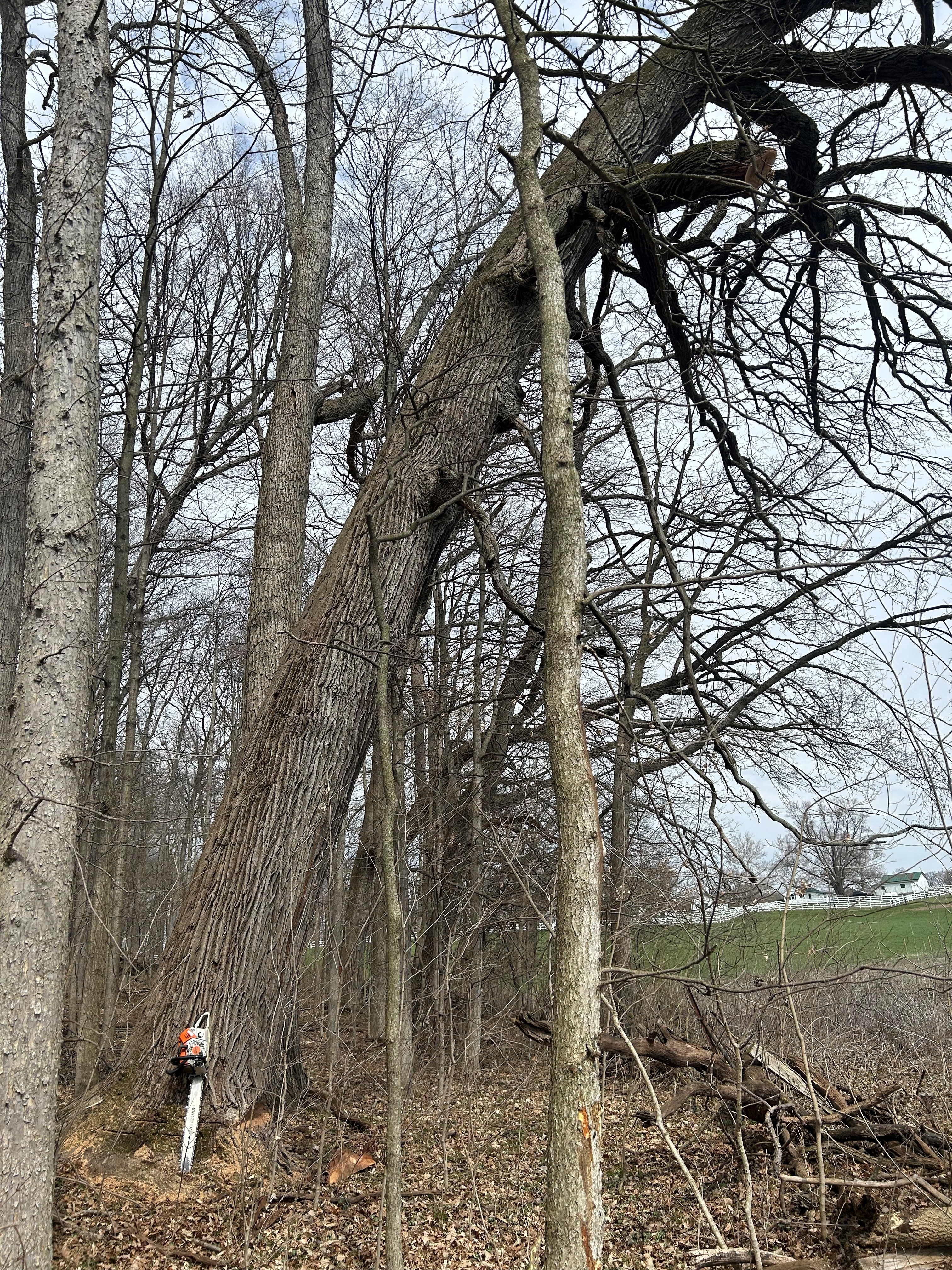
Hand cutting trees with heavy forward lean is dangerous and used to always make me nervous. Picture a tree leaning way out over a swamp or field edge. You know the drill. The trigger is not nearly cut off, but the tree is starting to pop and crack, and your feet involuntarily start dancing around in their eagerness to get out of there even though your mind knows you need to continue cutting until it's loose. It doesn't have to be this way!
Before I was taught the tongue-and-groove method, the best method I knew was to bore the back-cut on one side several inches higher or lower than the other side. This helped a lot and is faster than making a tongue-and-groove, but it was still inadequate for trees with very heavy forward lean. I don't claim to have extensive experience with the tongue-and-groove method because we had already switched to mechanical cutting before I learned it, and we seldom hand cut anymore. That said, it has worked as advertised every time I have had an occasion to use it.
Tongue and groove cut Triple Hinge cut
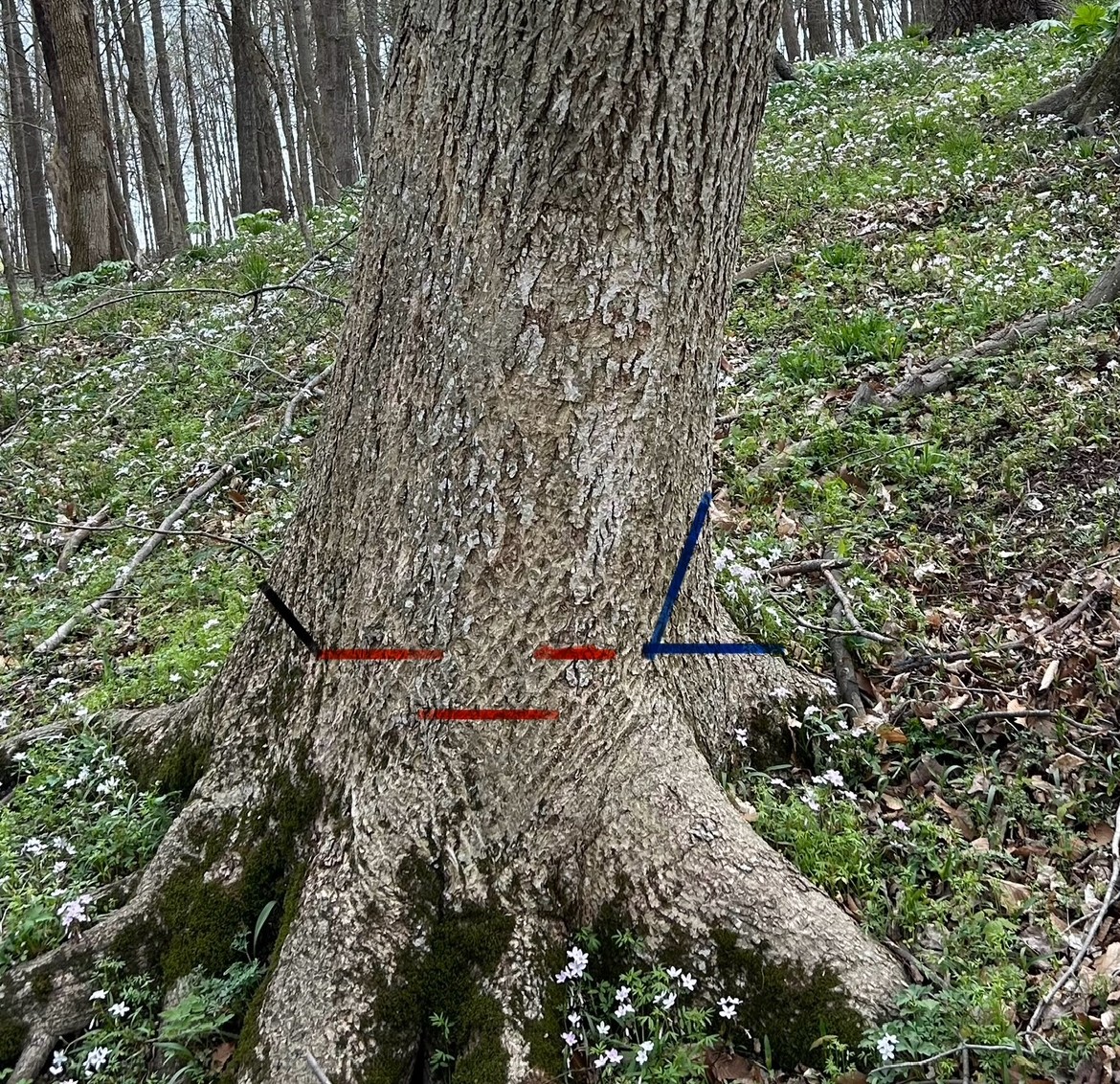
See the photo of a leaning Hickory for an explanation of how to execute this cut. The blue lines are the cuts for the notch, the red lines indicate where you would bore to create the tongue-and-groove, and the black line is the trigger. When creating the tongue-and-groove, it is critical to overlap your cuts a bit to ensure all the vertical fibers are severed. This can be a bit tricky if the grain is not flowing straight up and down. The beauty of this technique is two-fold: it helps hold the tree in place until you cut the trigger, and the tongue also keeps it from barber-chairing (splitting). You can even use this technique on a valuable tree that must be cut at ground level: you simply bore the tongue at an angle down into the stump.
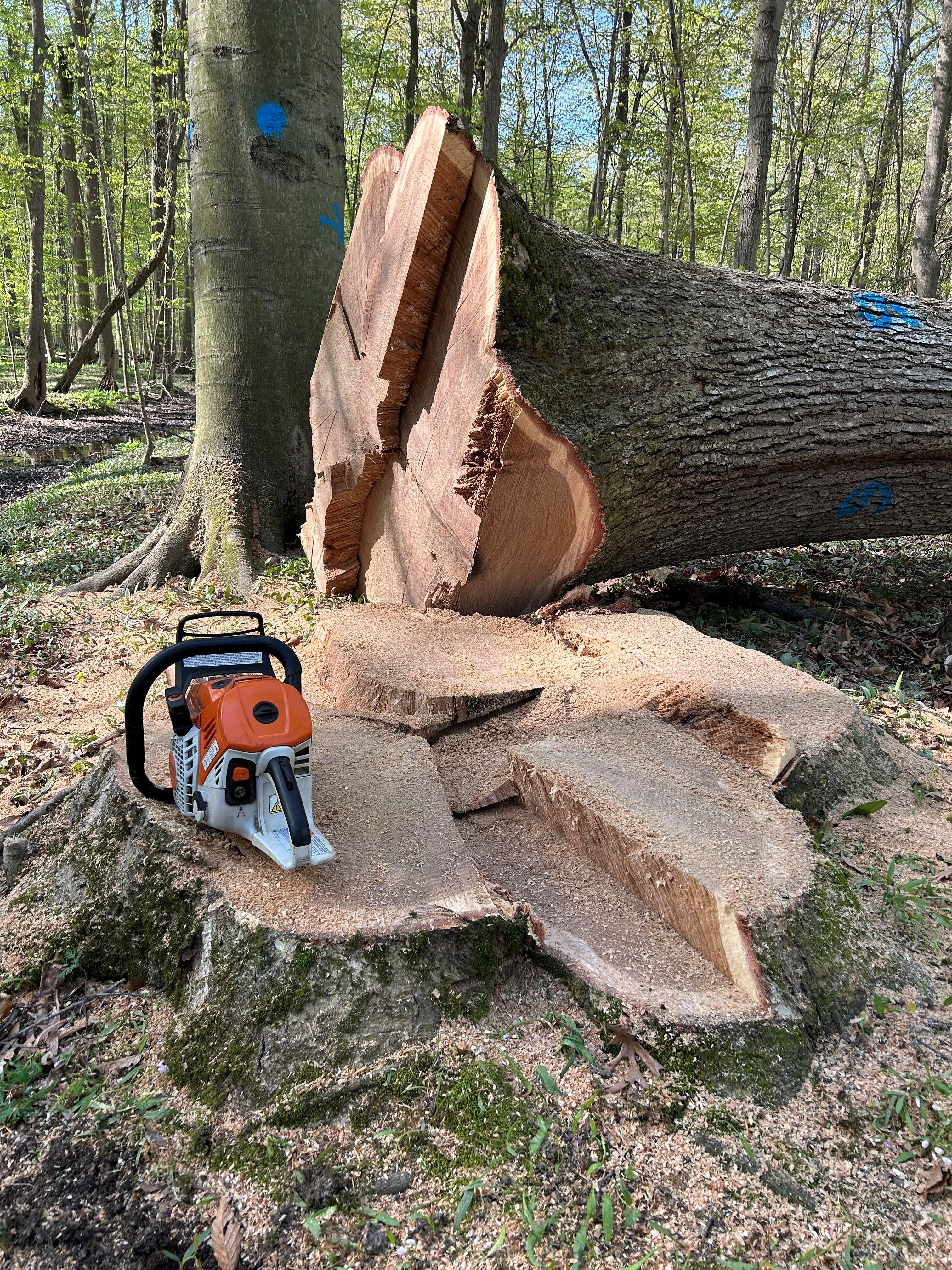
The photo of the veneer White Oak shows what the stump and butt log look like after felling. I don't normally cut the center out of the tongue, but since this was a large tree, I cut the heart out by boring in from the notch to be sure I didn't leave any uncut fiber. If I'd happened across a stump like this before I was aware of this technique, I would have had some uncomplimentary thoughts about the cutting skills of whoever butchered the stump. It's hard to teach an old dog new tricks but this "old dog" is thankful to have learned this method; heavy leaners are no longer frightening.
Double/Triple Hinge
This method is not often used but is valuable in certain situations. It serves to direct a tree that has significant side lean, but it only works if the tree also has a decent amount of forward lean. As you may know from experience, if we leave a thick, single hinge in an effort to swing a tree, some species will split, and others will break off before the tree is committed to falling the desired direction.
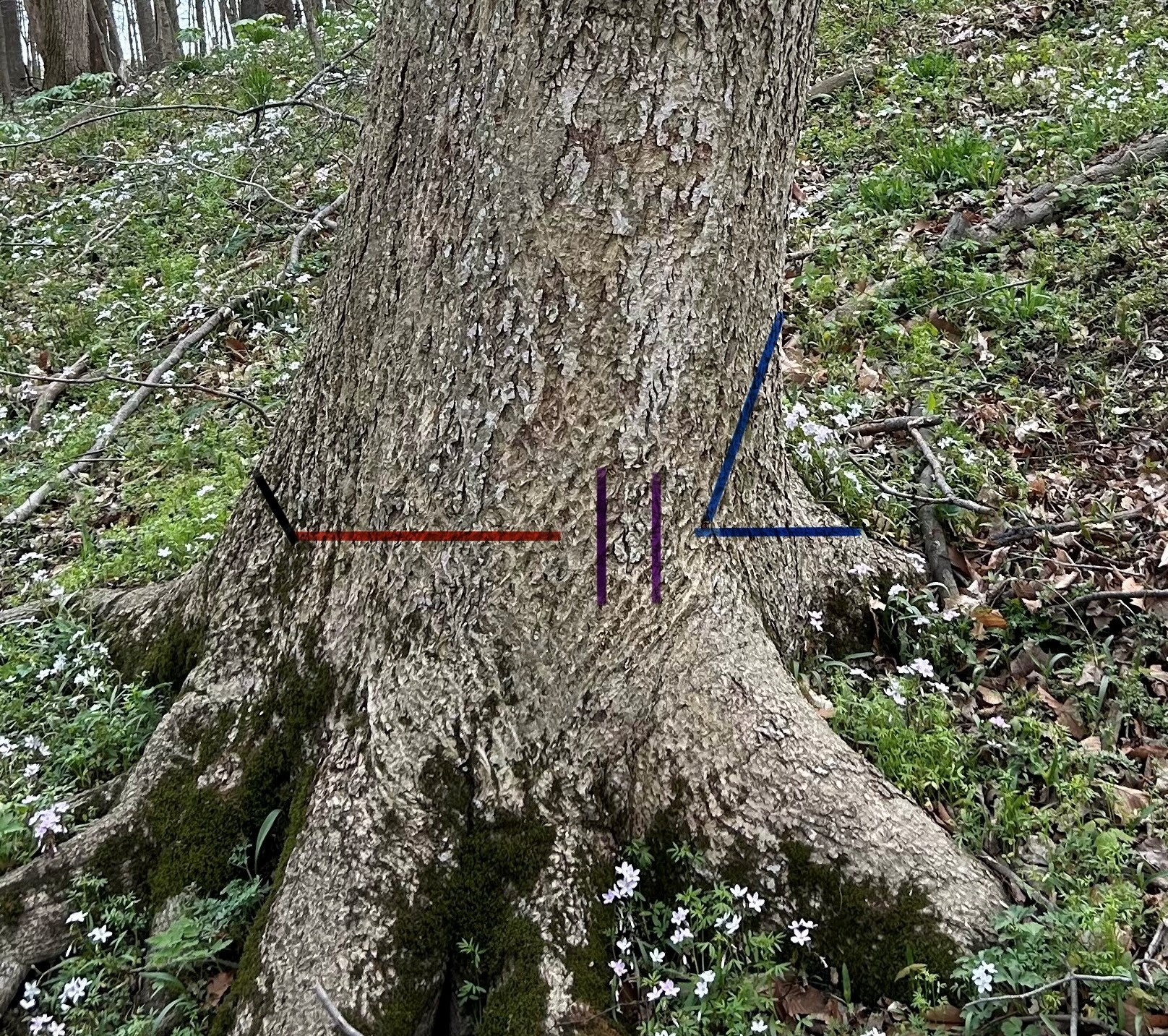
See the photo of the Hickory with a diagram of a triple hinge to understand the following explanation. Again, the blue lines are the cuts for the notch. The purple lines indicate where you would make two vertical bores. These vertical cuts should extend one bar width above and below the floor of the notch. The red line shows a normal back cut. The black line is the trigger.
By the way, a Hickory is not a good species on which to practice this cut. This method definitely allows you to direct a side leaning tree more than a single hinge. I don't understand why it works like it does, but apparently the vertical bores allow some flexing of the hinge that keeps it from either breaking off or splitting the log. I have seldom used a triple hinge, but a double hinge seems to work well in certain circumstances. To take a verse out of context, Solomon said, "Two are better than one; because they have a good reward for their labor." Same as with a single hinge; it's critical to know the fiber characteristics of the species you are cutting: a Black Oak sized hinge on a Hickory spells trouble.
Our lives are in God's hands. Let's trust Him, be careful, and be open to learning better methods. For anyone interested in more information about SAWW training, you can reach the office of Joe Glenn at 573.495.2050.
Ethan Royer, of Royer Logging, lives with his family in northern Indiana and provides logging services in northern Indiana and southern Michigan. He can be reached at 574.849.0867.
This article was originally published in Plain Communities Business Exchange (PCBE). Reprinted with permission. To subscribe to PCBE, call (717) 362-1118 or visit https://pcbemagazine.com