


By Ethan Royer
For loggers in the North and as far south as the Midwest, March and April is traditionally referred to as “spring breakup.” It's the time of year when the frost comes out of the ground it frosts, it rains a lot, and it's still too cold for the ground to dry out very fast. Last winter (‘23-‘24) we had only about two weeks of frozen ground, so there was no true spring breakup, just “mud season.” Plenty of rain in in the Spring is normal and expected but it's a bit depressing when it rains five days in a row.
For loggers, April showers bring more than just May flowers; they bring downtime and possibly even cabin fever. Someone has said, “More rain, more rest for the loggers in the Midwest.” In my opinion mud is the single biggest factor limiting logging production in this area. Little boys like dirt and water, especially if they are combined—the same cannot be said of loggers. I do not want to complain about wet weather because God does all things well. I suspect that if I were in control of the weather, we would have frequent prolonged droughts, I would get burned out, and my farmer friends would cease being my friends.
Sporadic Schedule
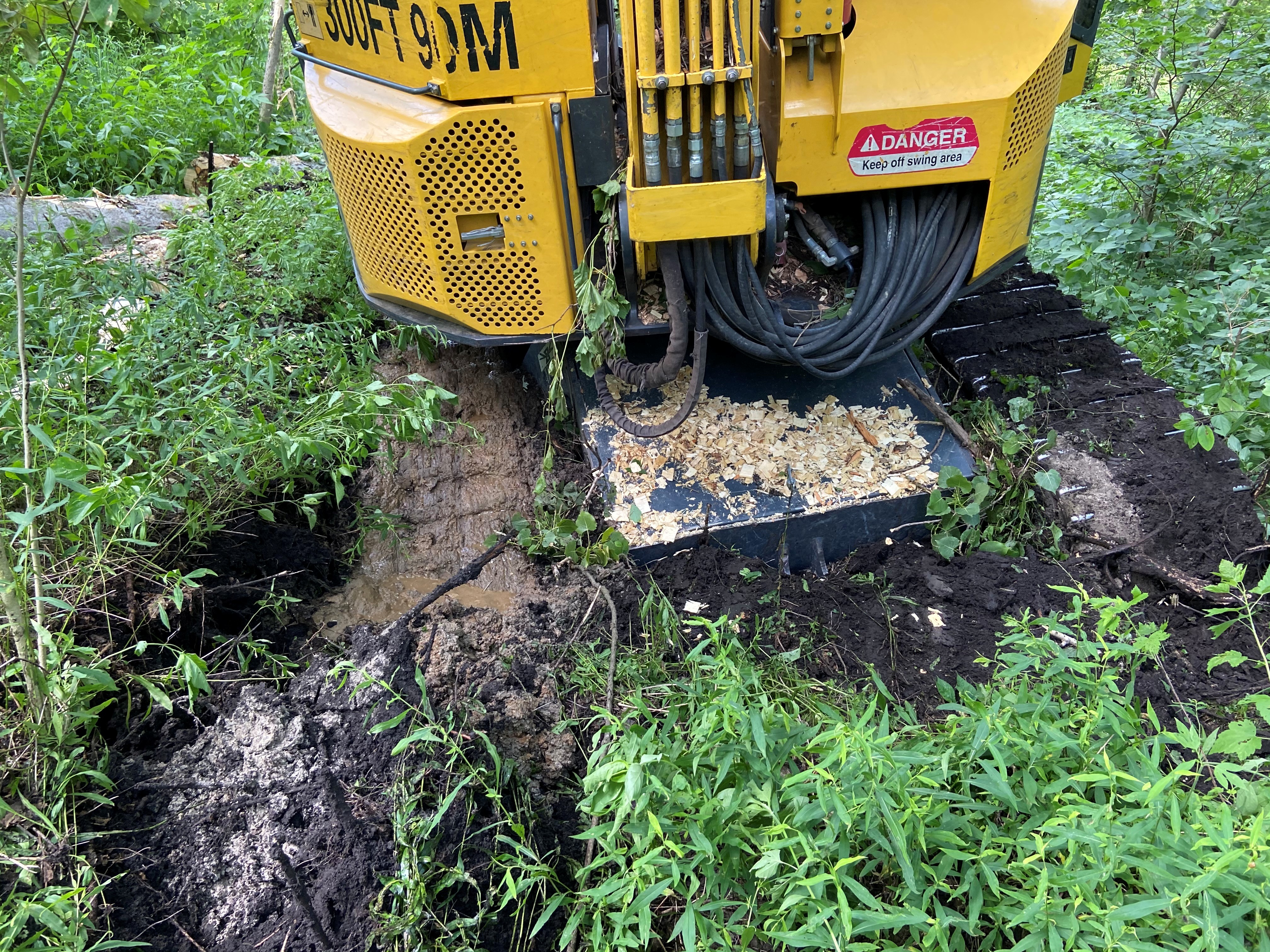
I have a love-hate relationship with a weather-dependent schedule, but it is an unavoidable reality of the trade. It is nice not to be gone all day every day, but it also means the schedule is as unpredictable as the weather. We are generally either rained out, battling wet ground, or pushing to finish up a job before the next rain event. This is exacerbated by the fact that many of our timbered areas are wet to begin with, making for something of a boom or bust schedule. We may be off for several days straight, then push extra hard when we can get back at it.
Having grown up with it, the unpredictable schedule is normal to me, but it isn't ideal. We have to be flexible: go when we can go and stay when we should stay. Sometimes a rain shower or a ground condition report completely rearranges the day before it starts. Working away from home, especially if you enjoy your work and have trouble shutting down at quitting time, can be hard on our families. Maybe weather dependency is a good thing to hedge against too much time at work. I know my wife appreciates rain days! You might think that with having off work on rainy days I would stay caught up with projects around the house, but you would be mistaken.
This on-again-off-again schedule is a negative that turns many people away from the industry. Most industrious men like steady work and do not like to work five days one week and zero days the next. It is challenging to find a profitable side hustle that you can work at when you want to but can shelve for extended periods as needed. I am an outdoorsman—almost everything I enjoy or am productive at is outdoors. While I do attempt basic maintenance, I am not mechanically inclined, and most of my mechanic work is an exercise in frustration, if not futility.
So you may wonder, what do we do to stay occupied on wet days? Proverbs 14:23 says, “In all labor there is profit...,” but it doesn't specify that it's financial profit. I keep a to-do list that gets longer during busy times, so I whittle away on that. There is typically no shortage of things to do. Sometimes the problem is deciding which task to prioritize. It's harder to get excited about tasks that aren't financially rewarding, but they're necessary too. I believe it is crucial to profitability to use downtime to do things that help us be productive and efficient when we can work again. Simple things like making sure our chain saws are sharp and fueled do add up to make a difference.
Quality Work = Not Working?
As mentioned earlier, the sporadic schedule is challenging and frustrating, so common sense indicates we should try to go work if there is any way we possibly can, right? Wrong. Trying to work when it is too muddy is the most common cause of unsatisfactory work in this area. In my experience, a crew can do an excellent job of cutting timber, minimizing collateral damage to the young trees, and avoid skinning trees along the skid trail, but if they leave ruts, no one notices anything else. On the other hand, I've observed that a crew can do a mediocre job of logging, but if they leave nicely smoothed trails and log yards, the owner is happy. I realize that our region may be somewhat unique in this because:
1. We have silty clay soils.
2. It's flat, so water sits instead of running off.
3. Everything is privately owned: we have almost no industrial timberlands or commercial forests.
4. Many landowners want to access their woods for purposes other than logging and can't if the trails are impassible.
Few crews around here have dozers, meaning we can only make ruts that we can repair with a skidder blade. We can try to justify our ruts by explaining that ruts are beneficial to regeneration (I've seen evidence of that), but that is a tough sell when there is no denying that ruts are ugly, hard to navigate, and may be indicative of careless work. There is no easy way to decide that it's too wet or that it's dry enough to log. You can usually tell by walking a woods whether it is dry enough, but there are times when it holds up better than expected and times that it is worse than it appeared.
Deciding when a job is dry enough can be a source of contention between loggers and the timber buyer or mill. Understandably, the mill wants to keep logs flowing in consistently, so they are more likely to pressure us to work when conditions are marginal. It seems that some timber buyers are more optimistic than realistic—I've often wished optimism would dry mud! As a contract logging crew, we are responsible for how a completed job looks, and it damages our reputation to leave a rutted mess. Perhaps a key component of a reputation for quality work is working less.
Managing Mud
Aside from impatiently waiting for the ground to dry, what are some things we can do to minimize our effect on wet ground and gain more working days? Some things are obvious, such as keeping an eye on the weather forecast and preparing skid trails before a rain event by making water diversions and blading it smooth to reduce ponding. It's no fun to return to the job after a gully-washer rainstorm and find that it was indeed a gully-washer that turned the skid trail into a small ravine. A skilled and attentive skidder operator makes a huge difference. Seemingly small things, such as not continuously running in the same tracks and occasionally dropping the blade to improve the trail or landing, combine to make a noticeable difference at job end. The skidder blade is there for more than a counterweight.
Equipment choice also makes a difference on how wet the ground can be worked without making a mess. Equipment salesmen are eager to persuade us that if we would just purchase this new piece of equipment, then we could work more and tear up less, but the prices they quote make us tear up (pun intended). Machine weight, tire size, track width, number of axles, bogie tracks, and the like all make some difference; the trouble is that the difference is hard to quantify.
Ground pressure is a big factor, but not the only important metric. For example, a big skidder has higher ground pressure than a small one, but the bigger skidder requires less passes on a trail to complete the same amount of work. We currently run a Tigercat 602 dual arch grapple skidder with 30.5" tires. This is about the lightest dual arch grapple skidder available and floats fairly well with larger tires. We have contemplated trying a forwarder for added flotation and fewer trips, but the price, transport size, complexity, and maintenance appear prohibitive.
One local recently purchased a six-wheel bogie skidder for improved flotation. I like the idea, but the main flotation advantage comes only by installing tracks on the bogie axles. This wouldn't allow driving it down the road, which we prefer to do when jobs are close together. While equipment choices can and do make some difference, I have concluded that for the most part, it is either dry enough or not dry enough. Things like wider tires help but aren't a game-changer.
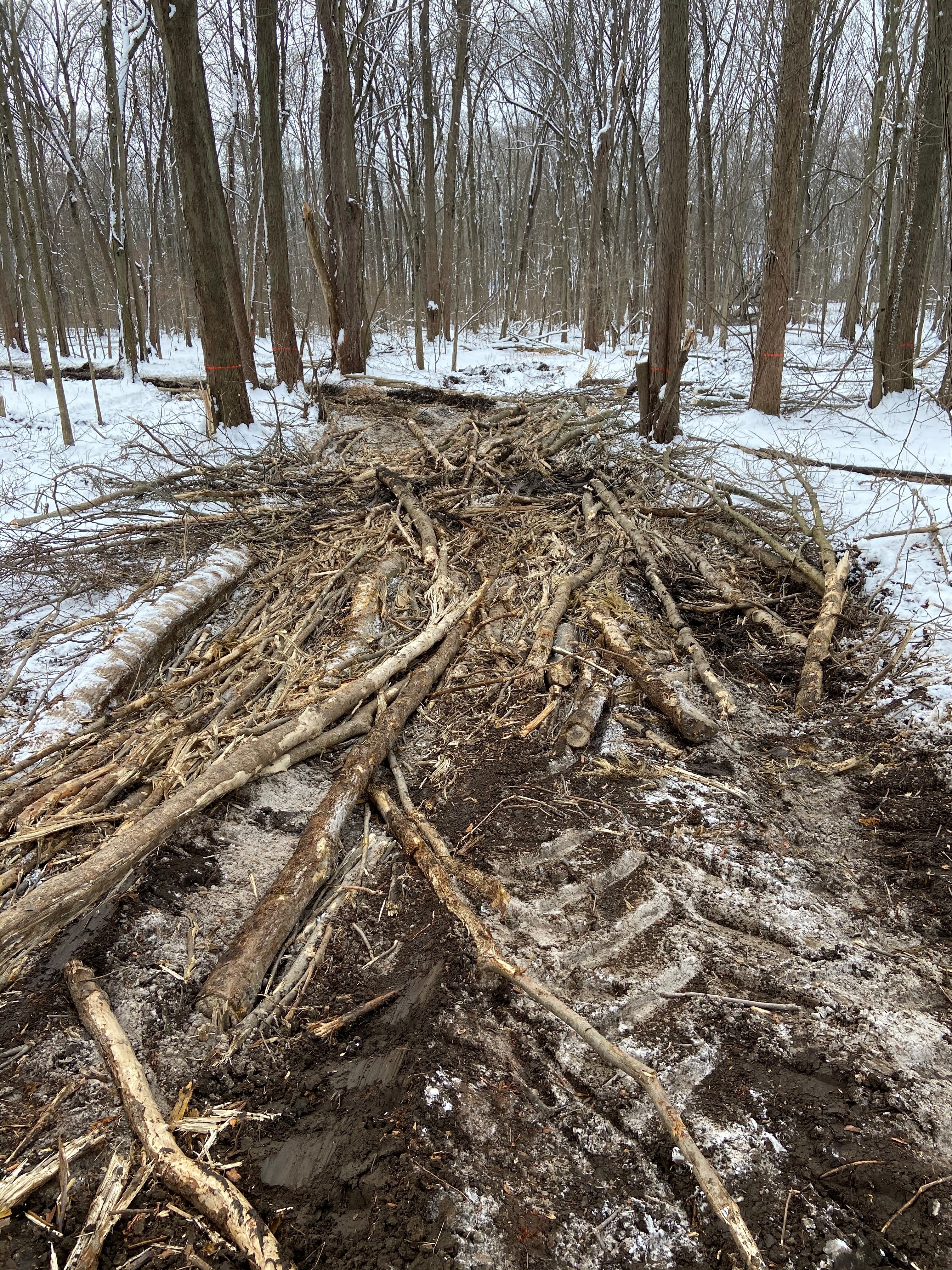
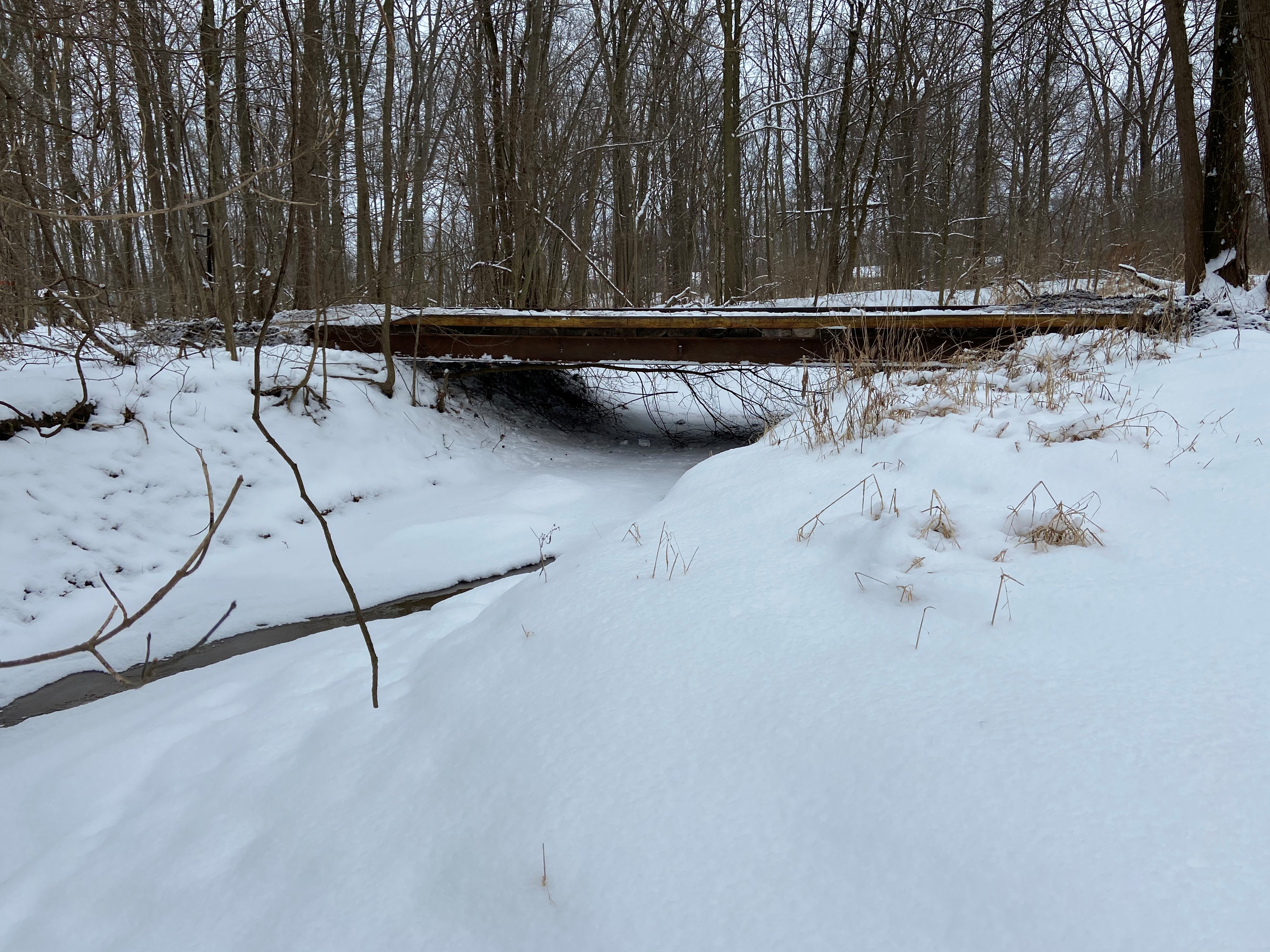
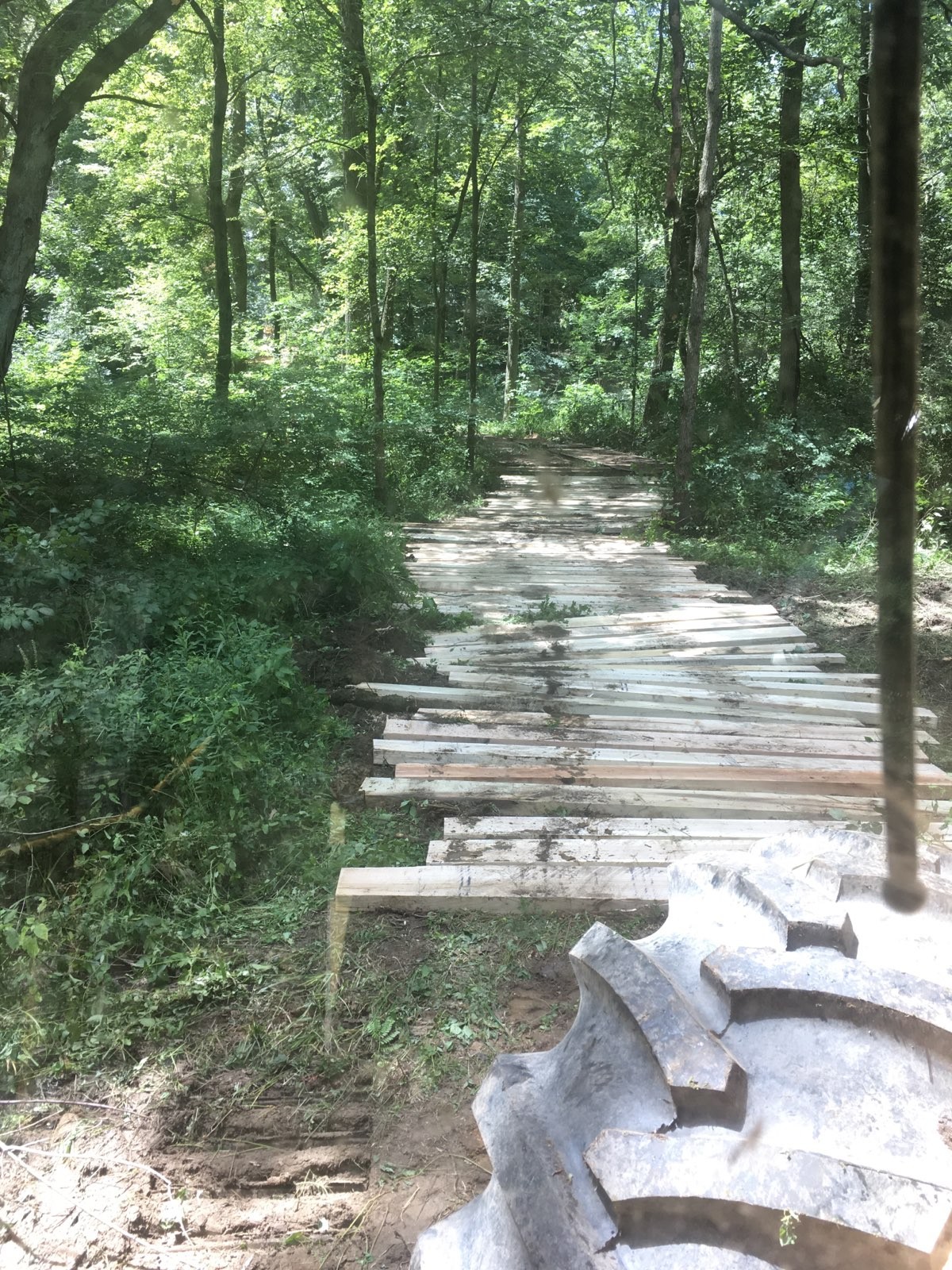
Even a job that is dry overall often has a few wet spots that cause grief. As one logger said, “Every skid trail has a wet spot in it.” There are several things we can do to get across these problem spots. Crane mats are convenient and work well but must be hauled in and out, adding expense. It seems that no matter how many mats you have, you always need just a few more. We have laid down cants when we lacked an adequate number of mats. If we need to cross a narrow, wet area, we can lay down logs to make a corduroy road, but covering much distance with this method requires a lot of logs and makes for a very rough ride. If there is a small wet area, it can work to lay down some trees or brush in line with the trail. This works but is not necessarily an easy fix or long-term solution. Bigger stems tend to spread apart, and smaller brush breaks down over time. It works better to lay down a brush mat before the mud gets deep rather than trying to patch up the trail after it's ruined.
River Bottom Challenges
There are certain jobs where it’s impossible to achieve an aesthetically pleasing outcome. I'm referring to those swampy river bottom jobs that are never dry enough. Around here, those jobs are typically larger tracts that are full of low-grade timber (think wormy Soft Maple) and are barely fit to work in the best of droughts. Since we often cut for a pallet mill, we seem to get into a fair share of these challenging jobs. It is never desirable to leave deep ruts, but I consider these jobs successful if we manage to get the timber extracted without burying a machine. I know of several jobs where some of the purchased timber never was harvested despite our best efforts. I don't feel too guilty about leaving ruts in a floodplain since the floodwaters smooth them out, and if it's such low ground that we can't avoid ruts, then no one else will be able to use the trails anyway.
It seems there is currently a lot of hype around “living close to the soil.” Loggers, however, prefer to remain a safe distance above the soil. I've seldom been as depressed as I was the day I sank the feller buncher in a swamp next to the Kankakee River. The Kankakee is a man-made river that drains the former Kankakee Marsh and has high banks that contain the river. In many places, the water is pumped up into the river.
I was about a hundred yards from the riverbank when I got stuck. Warning: if you are looking up at a river, you had better watch out! I knew it was wet, but I was not as concerned as I should've been because there were Hackberry growing there. Hackberry generally grows in sand or gravel instead of wet areas, but in this case, it was growing in a soil type called Marl—and it was definitely wet. In fact, it was so wet the skidder couldn't get close enough to reach me with the cable.
I was at a loss. I've been stuck before but never where the skidder couldn't help. We asked the farmer for suggestions. He had none but offered the use of his 5/8" chains (Who but a Kankakee farmer has 5/8" chains?). Dragging heavy chains through nettles in a swamp in 85-degree weather didn't lift my drooping spirits. We ended up hooking one end of the chains to a tree and the other end to a track pad. By simultaneously spinning the tracks and pushing with the boom, we did get out, and I was able to place brush under me as I tracked to higher ground. The marked Hackberry trees are still there, but thankfully the Komatsu is not. If there hadn't been a stump holding up the front of the tracks, I don't know what would've happened, but it would have been serious.
Knowing when to stop is a problem. If you don't occasionally test the limits, you'll end up leaving harvestable timber, but after you've gone too far, you'll wish you'd left the trees to rot! Recently, an area logger nearly buried his buncher in a river bottom. According to photos, had it been much deeper, the operator wouldn't have been able to open the cab door. The mud was up in the engine compartment, so the machine was inoperable and could not assist with extraction. Three 100-ton wreckers were finally able to extract it. I'm guessing it took quite a few trees to pay that bill. Unfortunately, we don't get paid for creating the “wildlife watering holes” that result from these bad experiences.
Dealing with soft ground is a challenge that won’t be going away. Be flexible, work hard when the sun shines, and be thankful for the time off when it rains.
Ethan Royer, of Royer Logging, lives with his family in northern Indiana and provides logging services in northern Indiana and southern Michigan. He can be reached at 574.849.0867.
This article was originally published in Plain Communities Business Exchange (PCBE). Reprinted with permission. To subscribe to PCBE, call (717) 362-1118 or visit https://pcbemagazine.com