


By Ethan Royer
As I begin this logging column, it may be helpful to make some introductions, detail our background, and give a general overview. Knowing some of our history, logging methods, and current equipment lineup should provide some context for the topics covered in this column.
I want to make it abundantly clear that writing logging articles is not an effort to portray myself as one who has a boundless knowledge of all things in the timber industry. Logging methods are very region-specific: I have found that no matter how much I think I know about logging in northern Indiana, visiting a jobsite in a different area reveals how much more there is to learn about the industry. I am simply someone who enjoys logging and writing, and I want to combine the two interests.
My experiences and conclusions may well be different than yours, and my opinions may change. As a fellow logger once succinctly put it, "I wouldn't give much for a mind I couldn't change". A unique thing about plain businesses is that we are generally willing to network and share ideas and experiences, even with competitors. It is said that experience is the best teacher, but I prefer learning by observation as much as possible. My hope is that you can find this column helpful, and perhaps by sharing, I can help you avoid some of the mistakes I've made.
Someone recently told me that loggers are some of the happiest people in the world because they get to work in a pristine natural environment and breathe fresh clean air. Naturally, this theory was coming from a non-logger. While I certainly do enjoy being out in the woods and can't think of any "office" I'd rather work in, I believe this theory is full of holes, for the following reasons:
- If a logger is using a chainsaw, he is breathing two-stroke exhaust and getting sawdust in his eyes and nose. He must also be laser-focused on his work if he wishes to escape injury (believe me, I know from experience) and actually make money, which leaves little time to "stop and smell the multiflora roses."
- If he is running a skidder or mechanical cutting, he is breathing heated or cooled air, same as if he worked in an office building, but perhaps with a superior view.
- Nature is a much more hostile environment than many people think. When most folks go out to enjoy nature, they are experiencing nature that has been tamed. For instance, they walk on cleared trails instead of struggling through the briers. After the fall in the Garden of Eden, God said the earth would bring forth thorns and thistles. God is always right, and the woods has plenty of evidence to prove it.
I do consider myself happy and I enjoy my work, but it's not that great.
History
I am a second-generation logger. My grandfather was a machinist, a meticulous trade that my father, David Royer, did not adopt, but which may explain his affinity for careful work. After spending one summer on a logging crew in California and a short stint working for a local logger, he founded Royer Logging in 1984. I have two sisters but no brothers. If the common conceptions about multi-generation family businesses are true, then my father worked hard to get it off the ground, I have it easy, and my sons will run it into the ground. It's too depressing to dwell on and besides, my sons are still young and may develop other interests.
Clients sometimes ask how many years I have been logging to which I reply, "I don't know." I grew into the trade, tagging along with Dad and/or the crew during summer vacation and after school, so I honestly can't pinpoint a starting date. When I was school-age, I remember writing numbers for Dad while he scaled logs in the snow. Keeping the figures legible with numb fingers was near impossible, but I can assure you that if whining would've warmed fingers, mine would have overheated. I'd guess I was about thirteen when I started operating a Timberjack 240 cable skidder (quite coincidentally, old family photos prove Dad's hair started whitening at about this time). I do know that I was felling timber with a Stihl 066 with a 28" bar at age fifteen. I was not forced to, I begged to. I am now thirty-five, so twenty years of experience should be a safe number. Twenty years of logging experience is not long enough to have learned it all, but it's long enough to have made a lot of mistakes and experienced plenty of close calls. Some of these mistakes and close calls may be featured in upcoming articles.
My advice to someone considering a career in logging? Feel free to give it a shot but don't do it unless you enjoy it—it's not easy money. As an old timer once told me when I complained about some hardship, "Son, if it was easy, everybody would do it." I could try to construe logging as a most noble profession; after all, who enabled Jesus' profession as a carpenter? My honest opinion though, is that it is a less-than-ideal occupation since we can't work at home, and it's difficult to incorporate our children into the operation until they're older.
Current Operation
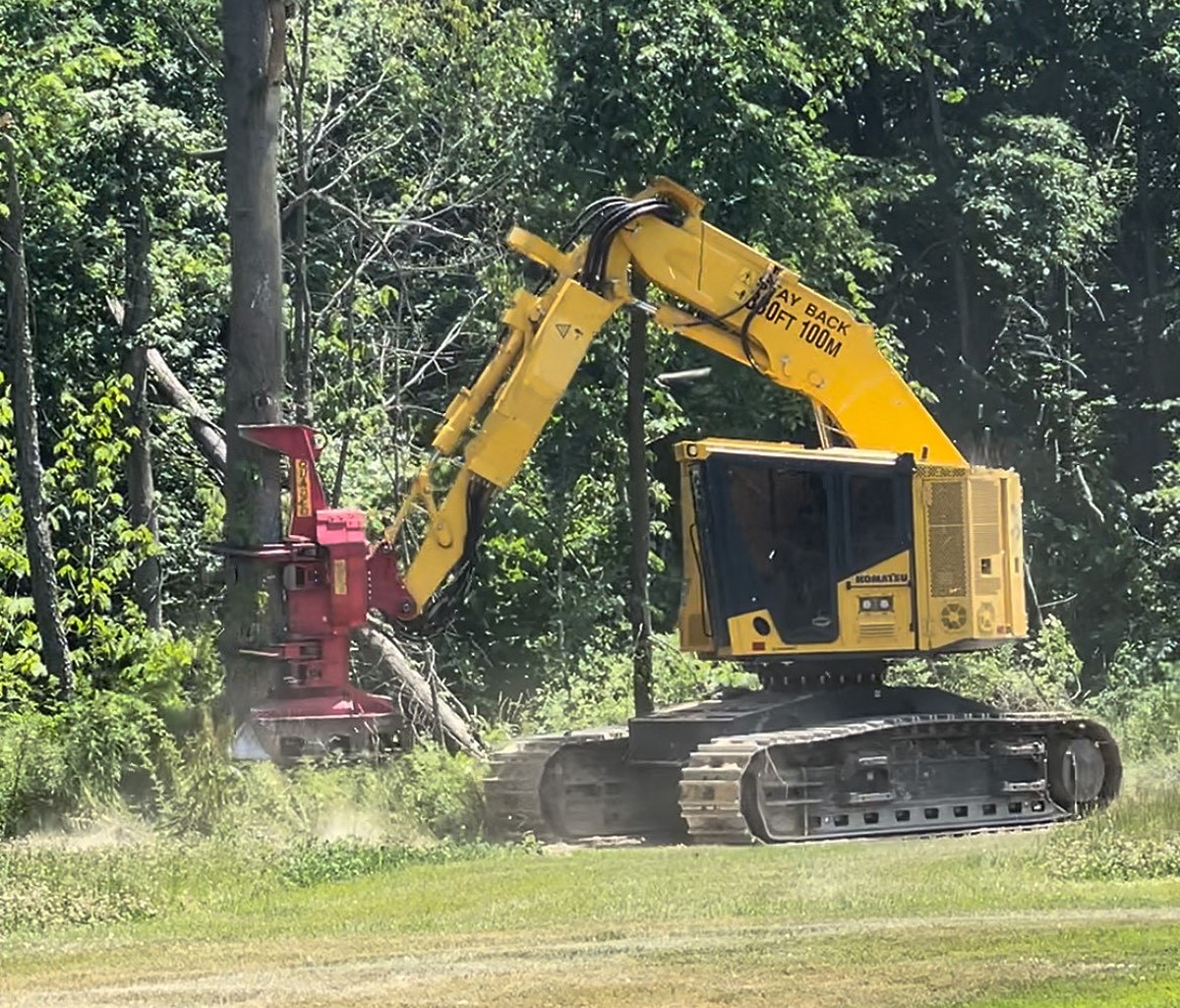
Dad still owns Royer Logging; he buys timber, markets logs, and hauls logs with a knuckle-boom straight truck. Dad's brother Tim hauls logs with a semi, loading with a payloader. Tim's son Jordan operated the skidder for the past ten years but recently found employment elsewhere. Fortunately, Felix Stalter agreed to come onboard and is presently learning the trade. I operate the feller-buncher and move equipment.
Dad owns the trucking side, and I own the harvesting side. Dad doesn't buy enough timber to keep us busy, and we can cut and skid quite a bit faster than Dad and Tim can haul it, so we alternate between cutting Dad's jobs and jobs for a local pallet mill. This mill trucks their logs, which gives our trucks time to catch up. In a typical year, we may cut 1-1.5 MBF (million board foot) for Dad and 2-2.5 MBF for the pallet mill. Pay is production based: the logs are scaled when they arrive at the sawmill, and we are paid a certain rate per board foot. We have had an additional crew in the past, but it is difficult to keep more people gainfully occupied with a weather-dependent work schedule.
When I first started helping in the woods, the equipment lineup consisted of a few chainsaws, an old 240 Timberjack cable skidder, and a Ford knuckle-boom log truck. As the years passed, newer equipment replaced the old, and additional machinery was brought on board to improve production and efficiency. Current lineup includes a 2019 International straight truck with a mid-mount Barko knuckle boom, a 2016 Peterbilt semi coupled with a Pitts log trailer, a 1996 Kenworth semi paired with a tri-axle lowboy, a 2016 John Deere 524KII payloader, a 444 John Deere loader of unknown vintage, a 2003 John Deere 548GIII skidder used as a pinch-hitter, a 2020 Tigercat 602 grapple skidder, a 2021 Komatsu 430-5 feller-buncher with Quadco 2900 head, and a mix of Stihl and Husqvarna saws. As you may observe, the concept of brand loyalty is not well understood around here.
Local Logging Context
When out-of-state folks come to northern Indiana and find out that I am a logger, they usually look one way, then the other, and ask, "Where do you work?" This question is understandable considering the scarcity of wooded acreage here compared to many other parts of the country. It is primarily farm country, but many farms do have a "back forty"; although as land prices increase, more of these "back forties" are disappearing. The main areas that are wooded in this part of the world are not conducive to farming. There are a few spots that are steep, but the terrain here is mostly flat; too swampy to farm is a more common cause of wooded land.
Our jobs do tend to be small, necessitating frequent moves. Jobs generally range from 10,000 to 400,000 board feet. Even if a timber sale could be larger, a consultant forester may break it down into several sales to make it attractive to smaller operators with less capital. The timber is almost all hardwoods. We have a few isolated pine plantations, but conifers aren't native and don't naturally regenerate here. We try not to drive more than about sixty to seventy miles but do occasionally go a bit farther.
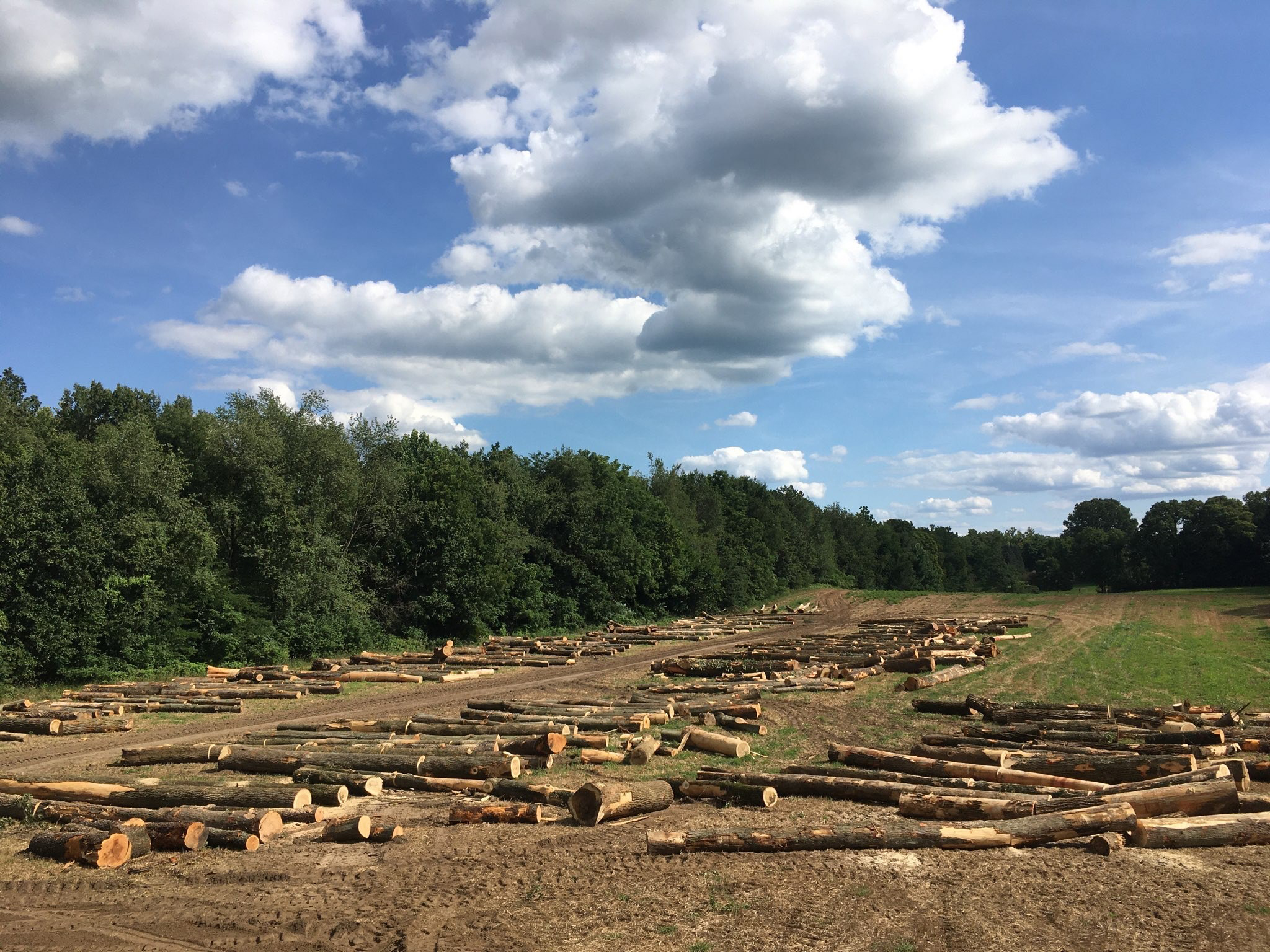
Most logging in this area is tree-length “hot logging,” regardless of whether it's a manual or mechanical operation. Hot logging means the logs are being skidded as they are cut; the cutter and skidder are working together. Most of our jobs are select cuts where careful work is important. I feel we can do a better job of minimizing damage to the residual trees by hot logging. There are certain scenarios, such as clearcuts, blowdowns, or a very heavy select cut where we may cold log, but it is uncommon. Logs are either hauled tree-length or manually bucked on the landing. I know of no one who uses a knuckle boom and bucksaw except at mill yards. Trees are limbed and topped where they fall, and the tops are left to rot.
The biggest challenge we face is wet ground conditions. The winter of 2023-24 was the worst I can remember for wet ground conditions, and the ground froze hard only for about ten days all winter. Our local weather station reported that it was the second warmest winter on record. The spring of '24 was no better: it seemed to rain about every three days. We were able to produce enough to keep the wolf away from the door, but that was about all. Prolonged stretches like that are depressing. It's helpful to keep a long-term perspective and not get bent out of shape by a bad month or two. Some time off isn't the end of the world; it's a good time to catch up on things that get neglected during the busy times.
I would enjoy hearing feedback from readers, whether technical questions, differing views, or constructive criticism. I also extend an open invitation for readers to come visit our jobsite if they are in the area and lose interest in fabric shopping before their wives do. I am not a smart businessman who knows exactly how much it costs to produce a board foot of timber; in fact, I have no idea. However, I do enjoy sharing ideas and visiting with others in the industry. That said, I highly recommend seeking business advice from those you know and are accountable to and not from some distant fellow who writes a logging column.
Ethan Royer, of Royer Logging, lives with his family in northern Indiana and provides logging services in northern Indiana and southern Michigan. He can be reached at 574-849-0867.
This article was originally published in Plain Communities Business Exchange (PCBE). Reprinted with permission. To subscribe to PCBE, call (717) 362-1118 or visit https://pcbemagazine.com